Wednesday, October 17, 2012

Top 7 Gaming Moments

I spend a lot of time talking about games, but not nearly enough talking about moments in games.  Games are memorable based on what happens, the crazy things people do, or making that one roll that wins you a game when you had almost no chance making it.  This list is a tribute to those moments, the things in games that I will remember for a long time.

#7 2008 - Starfarers of Catan
Who knew that a Saturday night in December could so drastically alter one's life. A friend of my next door neighbor in the dorms came by and asked if he wanted to play a game.  He was heading out, but he said "Ask the guy next door, he likes games."  So the guy asked me and I was reading for class, but I decided a diversion would be a nice thing.  So there I was, playing a game I had never heard of with 4 people I didn't know, but it was a blast.  I got into it really quickly, since it did resemble Catan.  I admit to having some amazing luck that game, and I ended up winning because of it.  But that's not the important thing.  That night sparked 3 good friendships, many nights of nights playing boardgames, mostly Cosmic Encounter, and truly finding where I belonged in College.

#6 2009 - Formula D
My dad and I are big Formula 1 fans, so buying Formula D for Father's Day was a perfect gift.  We didn't get around to playing until August, but when we did, what a race.  All 4 of us got together, and it was a tight race.  My dad and I got out to early leads, but my sister kept things close.  Dad and I were neck and neck going into Rascasse (2nd to last turn) when I hit the brakes just a little too late.  He was able to come out of the corner in a higher gear, and beat me to the line by about 5 places.  My sister was hot on my heels, but she broke late as well, which allowed me to get out ahead.  Racing around the streets of Monaco was a great way to break in Formula D.

#5 2007 - First time become lord of Catan
Late in the summer of 2007, I got together with my gaming family to play Catan.  I've been playing for nearly 9 months at this point, and I'd yet to win a game.  Now, I didn't really mind, since I was having a good time playing, but still, I really wanted to win.  I jumped out to an early lead by cornering the ORE market.  Most players needed to trade with me in order to build cities or knights, so I was a popular guy.  All of that was just enough to get me through, and at the end, I heard those words that felt so good, "All hail lord of Catan."

#4 2010 - First game of Munchkin
I'm not a huge fan of Munchkin these days, but back then I was young and naive.  I sat down to learn the game.  The rules basically made sense, and everyone seemed to have a good natured attitude towards it.  Then things got nasty, as they're prone to do in Munchkin.  Things were really close, everyone was at level 8 or 9.  Then it happened, DIVINE INTERVENTION, and oh look, I was a Level 9 Cleric, which made me a game winner, along with the other 2 Level 9 Clerics.  So we had a 3-way win thanks to Divine Intervention.  It has to be the least frustrating game of Munchkin that I've ever played.

#3 2011 - Shadows Over Camelot
In my 32nd game of Shadows, I was finally the traitor.  Now, not all of these games have used loyalty cards, but still, that's a lot of Shadows to play Loyal.  When I first saw the card I got excited, but I knew I couldn't show it.  I was playing Sir Percival, which has the power to look at the top black card before deciding on his evil action.  This is fairly useless, unless you have Lancelot's Armor.  So, I convinced the knights to let me get the armor.  I was victorious in my quest, but I knew I still had to play things loyal.  I couldn't always play really bad black cards, but I tried to pick the worse of the two, or at least what I thought would hurt more.  As it turns out, the game was running very loyal.  Loyal knights seemed to be cruising towards victory.  Then it happened, a string of bad black cards, Vivien, Mists of Avalon, Dark Forest, all in quick succession.  I knew this was my chance, so on my turn I chose the more hurtful of black cards.  I kept this up for 3 rounds, by then I was gathering some attention for my poor card play.  That's when I did it, I falsely accused a fellow knight, and then played Fate to send myself to Traitorland.  From there it was a relatively easy cruise for me, the game lasted another 2 rounds, and then the knights were no more. Muhahaha.

#2 2012 -  7 Wonders
I was at a game night, and we had an hour left to play.  There were 5 of us, 3 who had never played 7 Wonders, so I suggested it as something relatively light.  I set off to explaining the rules, and everyone seemed to understand what was going on.  There were some questions along the way, but that's to be expected.  By the 2nd age, everyone was going at a good clip.  In the 3rd age, I knew things were going to be close.  There was a lot of coins out there, and several key guilds in play.  We tallied up the scores at the end, 46-45-44-42-26.  I have never seen the top 4 covered by 4 points, it was intense.  The 3 new guys were 45-44-26.  I ended up winning, but I didn't think I had it until the score was final.  2 of the guys liked it so much, they went and bought the game for themselves.  That's the mark of a good time.

#1 2009 - My 2nd game of Battlestar Galactica
I'm playing President Roslin, and a key crisis comes up early on.  My turn comes to add cards, and I put them on the table.  My friend Aaron says something to the effect of "That's how a cylon plays cards."  I pointed out that I couldn't possibly play cards that hurt us, since both of my colors were positive.  He wasn't buying it though.  Everyone seemed to ignore it after we passed the check.  I was in fact a cylon in that game, and we did win when Admiral Tigh revealed himself as a bomber and destroyed Galactica.  Aaron knows me pretty well, and he's perceptive, but for him to call it that early still makes me smile.

Monday, October 15, 2012

Hidden Gems: Gem Dealer Review


Gem Dealer
  • Designed by Reiner Knizia
  • Published by Gryphon Games in 2008
  • For 3-5 Players
  • Plays in 20-30 minutes

Overview
Gem Dealer is a race to collect 4 different types of gems.  Players do so by bidding on one gem with cards in their hand.  Knowing when to bid and when to bide your time is a crucial aspect of the game.  It's fairly quick and keeps moving at a good pace.  

Components
Inside the box, rules are underneath
The gems are very stunning, one of the prettiest game components I own.  They don't look cheap, nor do they feel it.  The cards are good quality, though differentiating between purple and blue in low/bad light is challenging at times.

Mechanics
There are 5 different gems, of which players are attempting to get 4.  Players do so through a series of bidding rounds.  The first player places a gem up for bid, and then plays cards matching that color.  Each time they bid, they draw a card.  Other players can up the bid, or pass, drawing one final card and waiting for the next round.  There are some wild cards which can be used on any gem, though only one "10" can be used.  The 10 comes at a risk though, if you're not successful in your bid, you must return a gem you already own.  In each bid, a player may, one time, place any number of cards face down as a bid of 1 per card they play.  This is a good way to get rid of cards of a color you already have.  Overall, the mechanics are simple, but the wild cards and varying numbers on the gem cards do keep it interesting.

Interaction
All together now, "OOOOHHH SHINY!"
A lot of Gem Dealer is figuring out who is going to bid on something, and what to put up for bid next.  If everyone else has a blue gem, the odds are good that you'll be able to snag it without wasting too many cards.  The interaction here is about what you'd find in any other auction, though players are limited by their cards, not their own stop sign.

Theme
The gems are a nice theme, but I'm playing an auction/bidding game.  The theme could be animals, spaceship parts, etc. and the game would still work fine.  

Learning Curve 
Short.  It can be taught in roughly 1-2 minutes. There are some of those weird exceptions, only one "10" and the facedown anything bid, but the game is still quick to get people in and playing.

The different types of bid cards.
See what I mean about Purple(right) and Blue(left)?
Why I like Gem Dealer
It is a quick game with fun mechanics.  I don't have many bidding games, and the other ones I have are longer games.  The gems hook people instantly, and it opens the door to other games.  

Why I don't like Gem Dealer
There's a bit too much luck with the bidding cards.  Because players draw after each bid, one player could get a card of the color currently up for bid while another does not.  Also, the more bids you can make, the more cards you have, meaning you'll likely have cards for the next gem as well.

Replayability
My sister is a gem hoarder
I've played Gem Dealer 5 times in the last 2 or so years.  I've played it mostly at long games days as something that doesn't require too much thinking.  I think there's a time for it, but it's never at the top of anyone's want to play list.  I think it can be played more often and still be fun.

Overall
I like the game, but it seems like everyone would rather play something else.  Gem Dealer isn't a bad game, it just isn't great.  Maybe that's due to the theme.  If you look at tother games in the Gryphon Bookshelf line, theme plays a bigger part.  I give it 1 thumb up.  

Want to buy Gem Dealer and support BoBG?


Sunday, October 14, 2012

Collection Building: 2 Player Games

Sometimes, there are only 2 people around to play a game.  Now, often times this leads to other activities, but there are times when you want to have the challenge of a boardgame.
There are a lot of games that work for 2+ players, but I want to focus on 2 player only games.

Abstract games as a whole are typically two players and provide a great challenge.  Think of games like Chess, Checkers, Go, Backgammon, etc.  I don't know enough about abstract games, nor do I play them often enough, to recommend them.  Still, they are worth a mention in any list of 2 player games.

Lost Cities
Lost Cities is a card game where players are going on adventures.  There are 5 different adventures each player can embark upon.  Players do so by playing cards in ascending order from 1-10.  If they skip a value, they can never go back.  For each adventure you start on, you need to get at least 20 points, else you'll have a negative score.  Players typically play 3 rounds, and the highest combined score wins the game.  I've only played it once, but it was a fun game.  It's really easy to learn, and it only takes about 20 minutes to play 3 rounds.

1960: The Making of the President
Yes, you guessed it, a political game all about the 1960 US Presidential election.  Without getting political, 1960 was a landmark election in the US.  This game captures a lot of the back and forth of the race, and it's almost always close.  Players use cards, which represent different moments in the campaigns, for one of 3 things: action points, card text, the debates.  The game is somewhat long, typically 90-120 minutes, but it is a rich play experience.

Twilight Struggle
No, this has nothing to do with the books or movies. The game encompasses the entirety of the cold war.  One player is attempting to spread communism, while the other is trying to spread democracy.  This is designed by the same person who designed 1960.  I've only played this one time, but it's a very deep game.  Expect to spend a bit learning the rules, and then around 2 hours playing.  The game is well worth it, but it has a steep learning curve.

Memoir '44 (or anything in the Commands and Colors System)
Memoir '44 is a simplified take on some of the major engagements of WWII.  Players primarily use infantry and tank units to accomplish various objects.  Most engagements are a matter of eliminating the other side's units, but some involve controlling locations.  Players use command cards to issue orders, and dice to resolve combat.  The system is fairly easy, at least before expansions, and offers good variety with a plethora of scenarios.

Mr. Jack
Mr. Jack is a neat deduction game with one person taking on the role of Jack the Ripper, while the other player is the inspector hunting Jack down.  Jack will secretly be one of 8 characters on the board. The inspector is trying to narrow down the possibilities and eventually make an accusation, while Jack is trying to escape as quickly as possible, or last 8 turns.  I really like the mechanics of Mr. Jack.  The deduction aspect is interesting and challenging.  My problem with it is a lack of replayability.  Since it's a shorter game, I want to be able to play it more often, but it just doesn't lend itself to that.  Because every character is used in every game, the only real change is which role Jack takes, and then which side you're playing.  If you're looking for a neat 2 player game to add to your collection for those rare times you have only 2, Mr. Jack would work well, but if you play a lot with only 2, then Mr. Jack wouldn't be the first game I'd buy.

Price Wars


1960: ~ Looks to be Out of Stock, copies exist in the BGG marketplace for around $40.

From a pure pricing standpoint, Lost Cities wins out.  I think Lost Cities has the biggest potential to be played frequently, due to the short play time.  It's easy to set up, and play a round while you're waiting for someone else to show up.  It also works as a couples game for something quick to do before dinner or to wind down after a long day of work.

My pick for a 2 player only game to add to a collection is Lost Cities.  I liked it in theory before I ever played it, and playing it only made me like it more.

I'm by no means an expert on 2 player games, I just don't play them that often.  That being said, check out http://gameswithtwo.blogspot.com for more on two player games.  They have a lot of good suggestions, and a really interesting series on Risk Legacy.

Tuesday, October 9, 2012

Roll and Build - Roll Through the Ages Review


Roll Through the Ages: The Bronze Age
  • Designed by Matt Leacock
  • Published by Gryphon Games
  • For 1-4 players
  • Plays in around 30-45 minutes

Overview
Roll Through the Ages is a fairly short civilization building game revolving around dice.  Players have to balance a limited food supply, workers to build cities and monuments, and resources to purchase developments, all while worrying about the threat of disaster.  It may not be the most satisfying civ building game, but it is an enjoyable dice game.

Components
What you get inside the box
There aren't many components in RTtA, but what is in the game is superb quality.  The dice have custom images on them, I believe they're burned in with lasers, though I don't know that for sure.  The resource boards for players are made of solid wood, which is heavier than you'd think.  The only negative is the score sheets, which are use one per player per game and no more.  I ended up having 4 sheets laminated, so players could write on them with a felt pen and then wipe them clean.  This makes the game last a lot longer, and there's something about laminated pages that makes it more fun.

Mechanics
The 6 faces of the dice
The core of the game revolves around dice.  Players roll one die for each city they have in play (3 to start).  Each die can be rolled up to 3 times (think Yahtzee), but all disaster icons are locked in place.  After a player is satisfied with their roll, or out of rolls, they have to feed their cities (1 food per city).  Players then use workers to build cities or monuments.  The first player to build a given monument scores points (points vary based on the monument), while any subsequent builds yield less points.  Finally, players can use resources and coins to buy one development.  Developments do a variety of things, all of them useful in some way.  Play continues until either each monument has been collectively built at least once, or until one person purchases their 7th development.
I enjoy the balance between city growth and food requirements.  It brings a light tension to the game, while still allowing player choice.  There's a lot of different paths to take in the game when it comes to developments, and that's a good thing for RTtA.

Interaction
How things look at the start of the game
There isn't much direct interaction in RTtA, but there are two ways to affect what other people do.  The first is the disaster rolls.  Disasters stack, and if you roll 3, it affects your opponents, instead of you, though the risk of rolling a 4 is far more hurtful to you than sitting on 2 disasters.  The other way is through monuments.  The drop in points for subsequent builds is significant, so if you see someone trying to build the Great Pyramid, you might devote your workforce to finishing it before they can.  If that sounds a little too mean, don't worry, it's not.  You still get something from the effort, and they've wasted a lot of resources to take a few points away from you.
The interaction is fairly passive, but it exists.  It is playable as a solo game, which tells you that the game does not depend on interaction.

Theme
I don't really feel that I'm running a civilization, or helping to construct it, but the civ building aspect does come through.  Sure, the theme could be several different things and still work, but something just feels right about the civ building.

Learning Curve
Things after a round
Here we have a tale of two parts.  The game isn't complicated to learn, less than a 5 minute introduction.  However, the odds are that you won't have much of a strategy until after you play through once or twice.  Now, for people who are familiar with civ-building games, they will have a decent idea of what to do, which makes things run smoothly.

Why I like Roll Through the Ages
Firstly, it was a gift from Secret Santa, including the laminated score pages for the base game and the expansion, so there's some sentimental value there.  As for the game itself, it's the luck of the dice with a fun game built around it.  You have to make the most of whatever you roll, which is easier said than done.  There are several different strategies to explore from game to game, which offers a lot of depth.

Why I don't like Roll Through the Ages
Luck of the dice.  Sometimes you really need 3 food and you roll 1 good two times in a row.  There's not much you can do about it, other than absorb the lost points and make something happen with the good you got.  The game can suffer from a runaway leader since developments make the game go faster, and once you get going, you rarely stop.

Replayability
I've played RTtA 12 times with a couple different groups of people.  The different paths to take with developments and monuments keep it interesting.  Adding in the expansion also changes the arc of the game.  It makes it a little longer, but also gives players more opportunities to score points.  RTtA isn't something I want to play all the time, but I like it every so often.

Overall
My civilization at the end of the game.
Roll Through the Ages is a game I enjoy.  It's my favorite dice game, though there are some other dice games that challenge for that title.  I've liked the idea of Civilization building for a long time, I think there are a lot of great things to explore there.  The issue I've always had with them is how long they take to learn, and play.  RTtA scratches the itch, and does so in under an hour.  It is an innovative take on the genre, it streamlines Civ building to the core ideas, and it gives players options.  Overall, it's a 2 thumbs up, and a keeper.

Will you like it?
If you like dice games, you'll enjoy this.  If you like civ building, you'll enjoy this.  If you like well designed games, you'll enjoy this.  Of course I can't make guarantees that you'll enjoy the game, but I've yet to play with someone who disliked the game.  Some have been lukewarm, others have liked it.

What else is like Roll Through the Ages?
It depends on what you're looking for.  If you're looking for dice games, check out Can't Stop, Dice Town, Alien Frontiers, and other games on my Collection Building: Dice Games article.
If you're looking for the Civ-building games, there are some options.  Consider Sid Meier's Civilization: The Board Game, Through the Ages, and Glenn Drover's Empires: The Age of Discovery.  I haven't played any of them, so I'm going on what I've read through BGG and other reviewers.

Want to buy Roll Through the Ages and support BoBG?


Monday, October 8, 2012

Money, Money, Money! Review

Money!
  • Designed by Reiner Knizia
  • Published by Gryphon Games
  • 3-5 Players 
  • Plays in around 30 minutes
For this review, I asked my friend Rose to write her thoughts on the game.  I've played Money!, but not nearly as much as she has. Ergo, I felt she was better suited to giving a review than I was.


Overview
Give away money to try to get more money! Try to collect entire currencies for the most points.

Components
A look inside the box.
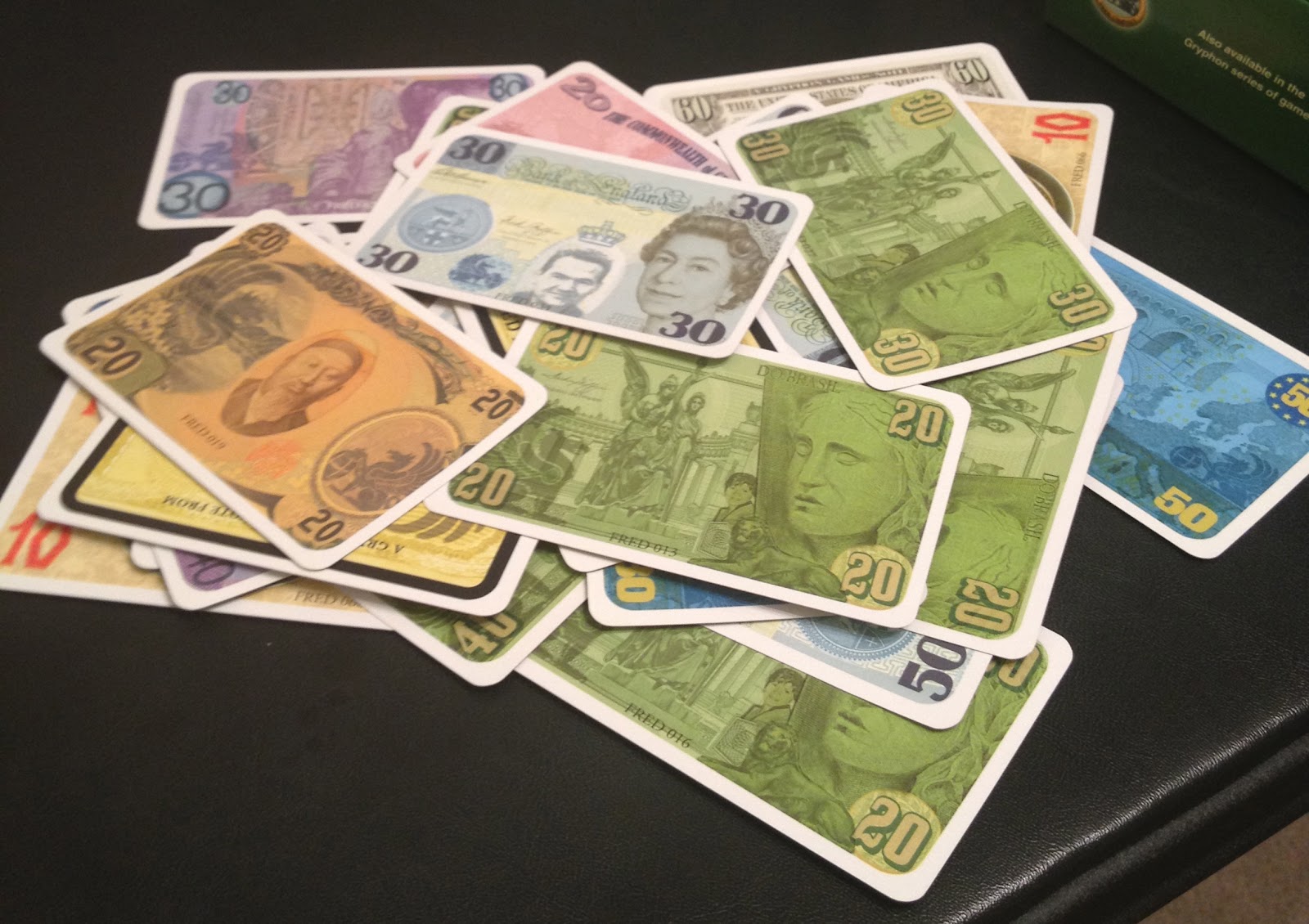
Money is a pure card game; it comes with 69 currency cards and 5 bluff cards. The cards are sturdy and attractive; all currencies but one are close replications of actual real-world currencies (US dollars, Australian dollars, yen, pounds, Euros, etc.). The cards are a bit large, which can make holding them all difficult as your hand swells, but that is my only complaint.

Mechanics
Each turn, two sets of four cards are laid out. You place cards from your hand face-down to bid on the available cards. The person with the highest bid gets the first choice and exchanges the cards they bid for the set of cards they want, second highest bid gets the second choice, etc.

The goal of this is to get the most possible points. You get points by having complete/near-complete sets of currency (three 20s, three 30s, one 40, one 50, and one 60). 

All of the green currency cards
The rules for scoring are somewhat complicated. At the base, cards are worth their face value. The 20s and 30s, if you have all three, are worth an extra 100 points each, making the three 20s worth 160 points and the three 30s worth 190 points. These, plus the 40, 50, and 60, make a possible total of 500 points for a complete currency. However, if you have incomplete sets of currency, it gets more complex. If you have over 200 points in face value of the cards alone, you get the face value. If you have less than 200 in card face value, you get the face value of the cards minus 100. The bonuses for the sets of three are added in after these calculations. If the total is less than 100, the cards are worth nothing, but there is no penalty. Additionally, there are six Chinese coin cards, each of which is always worth 10 points, no matter how many of them you have.

Interaction
The main interaction in Money is trying to figure out how much other people are bidding and how badly you want to beat them for a particular set of cards. Because the bids are placed face-down, all you have to go on is the number of cards placed. The actual value could range from 60 to nothing, since each player has a bluff card they can use to “pad out” their bid to make it look bigger, or pass on a given hand entirely.

Theme
International currency! The theme is the driving force of this game, and as such it works very well.

One of each type of currency card
Learning Curve
Medium. It takes a playthrough or two to get the hang of how the strategy of the game works.

Why I like Money
I like the bidding mechanism; the only other games I've played with bidding were bridge when I was a kid and Monopoly (which was actually my favorite part of Monopoly). It's complex enough that it stays interesting, and there is some skill and strategy involved, but there is a certain amount of dumb luck, which means it's not overly intellectual.

Why I don't like Money
Nice big pile of Money!
The scoring is somewhat complicated, and with the physical version, it's hard to tell which set of cards will increase your score more (there's a version for the iPod/iPhone/iPad where it tells you what a set of cards will do for your score). As I mentioned, the cards are a little big, which can get cumbersome.

Replayability
Very replayable. I usually play at least three games in a row.

Overall 
Money is a fun, quick game. Once you get the hang of the scoring, it's not very complicated, but it's not simple enough to get boring quickly either. I'd give it one thumbs up.

What else is like Money?
Bridge is the closest relative I can think of, but it's a fairly distant cousin on the family tree.

Want to buy Money and support BoBG?


Sunday, October 7, 2012

Top 7 Cosmic Encounter Powers

I know this won't pertain to all that many people, but it's something I've been mulling over for awhile.  Cosmic Encounter is my favorite game, so I think about it often.  One of the questions I got a lot is "what's your favorite power?"  This list is meant to explain some of my choices and give some of my thought process behind the choices.

#7 Fury
Fury gains a token for each ship they lose to the warp.  They can use these tokens to add or subtract 3 per token from their side in an encounter.  Fury has to play a balance game between ships and tokens, but if Fury is smart, they'll be a key player at the end of the game.

#6 Genius
Genius wins if they have 20 cards in their hand.  Often this is hard to accomplish, but certain flares can help.  Genius does have the ability to forgo claiming a colony in favor of drawing cards.  This gives Genius great flexibility.  It is more powerful in a hidden power game, since no one really knows why you're accumulating the cards, but it's still a solid power, and a lot of fun to play.

#5 Miser
Miser plays the game with 2 hands of cards.  This gives them a lot of options when it comes to playing cards.  They're still stuck with bad cards, just like everyone else, but they can also manage their main hand better, thus keeping flares and artifacts around longer.  Miser isn't a power that's feared, and rightly so.  It won't directly help you win a combat, but it does give you more options, and in a game that relies on cards to win the game, having more cards is a good thing.

#4 Sorcerer
Sorcerer has the option to switch the encounter cards that the main players play before their value is revealed.  Sorcerer is a giant mind-game, which often leads to a Princess Bride esque moment that goes something like this.  "I think you're the kind of person who's going to swap cards so I'll play card A. But knowing that you know that I think that you'll swap means you won't, so I'll play card B. But knowing that you know that I know that you know that I think you'll swap means you will, so card A it is." And so and and so forth.
Sorcerer lets you make something good out of the bad cards in your hand.  It does require a certain finesse to use well, but it's also easy to play the first time you see it.

#3 Pacifist
Pacifist is one of the simplest powers to explain, you win if you play a Negotiate.  Now, you can still win an encounter the normal way and an N v N still leads to a deal.  Pacifist is great because it allows you to utilize every card in your hand.  There is that bluffing aspect where players don't know if you'll play a Negotiate, so you can slip in a low attack card while they go for the N to try to deal.  Pacifist is a great power for using all the cards in your hand.

#2 Remora
Remora is just a bit clingy, maybe too clingy.  What I mean by that is Remora gets a card whenever someone draws cards, and a ship whenever someone takes a ship back.  It means that they'll likely never run out of cards, and will likely never be low on ships.  Remora continuously brings a supply of cards, which should help in combat.  Remora itself won't help you in combat, but the additional cards and ships make you a bigger threat as the game goes on.

#1 Chosen
Chosen is the power I would pick if I had a "must-win" game of Cosmic.  Chosen's power is to draw 3 cards after encounter cards have been revealed. He can then use one of the 3 cards to add to his encounter total, or replace the card he played.  This has a two main uses.  If things are close, you just gained a reinforcement card of some value.  If things are way against you, you can hope for a Negotiate to at least take some cards from your opponent.  Chosen isn't forced to add or replace anything, so his power can never hurt him.

Every power has good things and bad things to it.  Different powers suit different play styles.  Someone else's top 7 may be completely different than mine, but that's a good thing.  I think every power (110 to date) has something to offer.  Sure, you may not like all of them, but each and every power could come out victorious.

Thursday, October 4, 2012

Top 7 Game Publishers


I try my best to judge a game based on the merits of the game.  One of the merits of a game is the company that publishes the game.  This isn't always a guarantee that the game will be great, but there are some companies that excite me more than others.

#7 Tasty Minstrel Games (TMG)
TMG is an up and coming company.  They've had some early successes with Homesteaders, Belfort, Martian Dice, and my personal favorite from them, Eminent Domain.  They've had some growing pains, but they're a company looking to publish great games, and provide fun games for families and gamers alike.  I've enjoyed the TMG games that I have played, and I hope there are more to come.  A few are in need of an expansion, and I hope TMG focuses on building up their existing product line as well as adding quality to it.

#6 Gryphon Games (Part of FRED distribution)
I've enjoyed many Gryphon games, from the non-gamer favorites of For Sale and Can't Stop to the slightly heavier Roll Through the Ages.  Gryphon Games targets casual gamers who are looking for an enjoyable play experience in a relatively short time. (Under 1 hour, typically around 30 minutes)  Games that are fun and short tend to be a hit with people of all ages and gaming backgrounds.  I really appreciate having games like that around, since I can introduce them to people and play almost instantly.

#5 Wizkids
Wizkids is fairly new to boardgame publishing, but they've made a big splash.  When they acquired the Star Trek license, my Trek fanboy heart was overjoyed.  When I saw what they did with Star Trek Fleet Captains, and to a lesser extent, Star Trek Expeditions, I was simply amazed.  Wizkids has been in the HeroClix business for a long time, so they're no stranger to amazing sculpts of characters and vessels from a variety of properties.  Wizkids has published some very strong games in their short existence, including the highly innovated Quarriors, and the highly intriguing Mage Knight.  They're a company on the rise, and I look forward to seeing what the have in store.

#4 Rio Grande Games (RGG)
RGG is best known for Carcassonne and Dominion, which are two games I rate highly and enjoy.  Those two games also show the two paths that RGG has taken in game publishing.  In their early days, RGG was primarily a game importer.  They sought out great games in Europe and brought them over to the US.  With Dominion and Race for the Galaxy, RGG started publishing some of their own games.  I've greatly enjoyed this shift, since I'm not a huge fan of "euro" games.  RGG has a good blend of games, and I think they're a company that offers something for everyone.


#3 Z-Man Games
Z-Man takes the shotgun scatter approach to games.  They like to publish a lot of games and see what sticks with their audience.  There isn't anything inherently wrong with this approach, though it can lead to some good games not getting the recognition they deserve.  The best Z-Man game I've played is Pandemic, but they have published a lot of other really good games: Agricola, 1960, Ascending Empires, Ares Project, No Thanks, Neuroshima Hex, and countless others.


#2 Fantasy Flight Games (FFG)
FFG is best known for large scale productions.  Twilight Imperium, Descent, StarCraft, Rune Wars, and many more.  I've yet to play one of their "coffin box" games, choosing to focus my efforts on some of their smaller games, such as Cosmic Encounter and Space Hulk: Death Angel the card game.  FFG is well known for stunning production quality.  They put a great effort into miniatures which make their big games look fantastic.  FFG is also known for their LCG (Limited Card Game) lines.  They have taken the business model of a randomly distributed card game and modified it with predefined chapter packs.  This allows everyone to own all the cards for a set price.  FFG has a superb commitment to quality and growth in the board game industry, and a propensity for expansions.  

#1 Days of Wonder (DOW)
DOW has made some truly great games, Ticket to Ride and Shadows over Camelot are two of my favorites.  Every DOW game that I've played, I've liked.  There are some that are better than others, but all of them have something to offer.  DOW focuses on superb quality and a very small quantity.  This keeps people coming back from more, without feeling that they could never keep up with the flow of new releases.