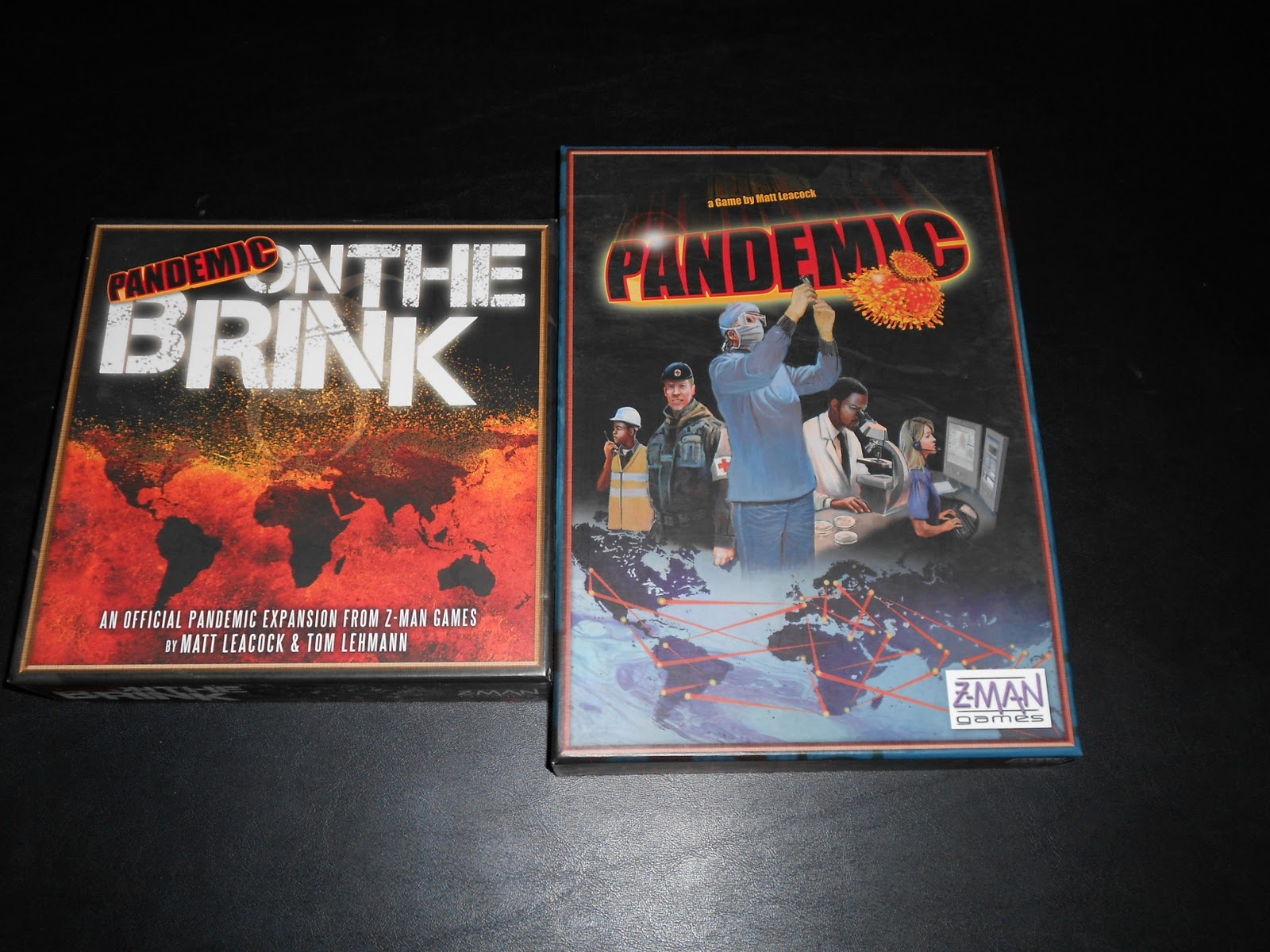
Forbidden Island
Matt Leacock
Gamewright Games
2-4 Players
Plays in about 30 minutes
Pandemic
Matt Leacock
Z-Man Games
2-4 Players (5 with Expansion) Plays in about 60 minutes
Since these two games share a lot of similarities; same designer, both are co-operative games, and both share similar mechanics. With that in mind I’m going to review both at the same time, pointing out their differences, giving each part a running score, with no ties allowed, and always a point difference, and we’ll see which one I like better when all is said and done.
Overview
 Forbidden Island is a family geared co-op game, meaning that everyone works together against the board. Players find themselves on a sinking island where they must collect 4 treasures and then get off the island before it sinks completely. There are several ways to lose the game, but only one way to win.
Pandemic is geared a bit more to the medium gamer. It’s also a co-op game, but this time you’re members of the CDC (Centers for Disease Control, which is headquartered in Atlanta, thus the starting point) who are trying to find cures for 4 major diseases while treating the diseases around the world. Yet once again, many ways to lose, only one way to win.
Components
 |
All the treasures stacked
Photo courtesy of Tahlia M. |
Pandemic has a few more components, but Forbidden Island’s are snazzier.
Pandemic has a fixed board which I think gives it an edge in game to game balance. It also allows for outbreak trackers as well as how many infection cards to draw each turn. Forbidden Island counters with a tile for each land area. These tiles are of great quality, and have a normal side, as well as a sinking side. Forbidden Island has the advantage of being random each time you play, which is nice to have variety.
As I alluded to at the start of the section, Forbidden Island has snazzy components, which come in the 4 treasures that the adventurers attempt to collect.
As it always does, it comes down to scores. Both games have excellent components, but snazzy wins out, so Forbidden Island 10, Pandemic 9.
Game Mechanics
 |
Yes, I do have a rubber glove
for handling the disease cubes
It's a joke from a former roommate. |
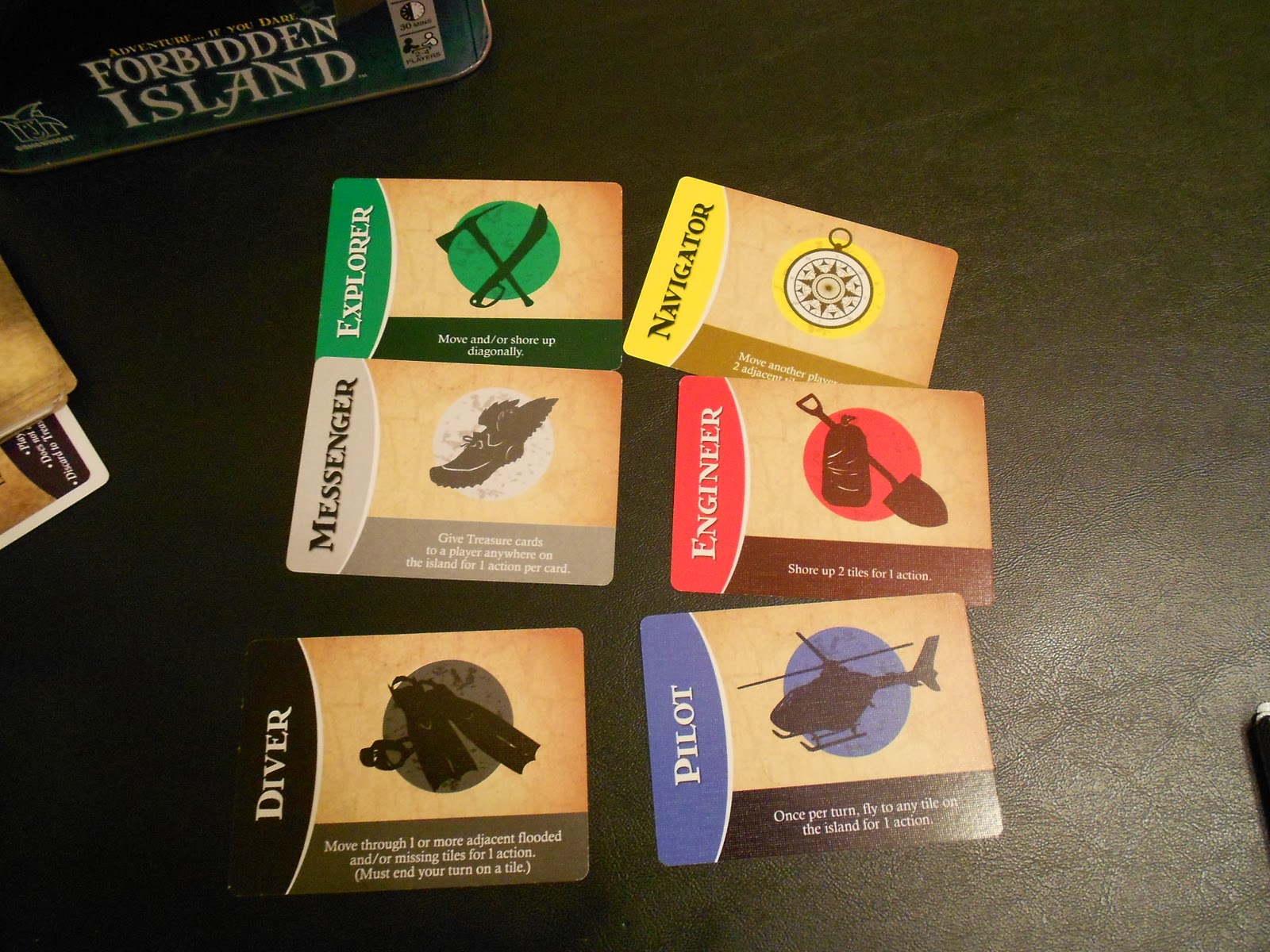
Both games involve players getting a set number of actions each turn, trying to move around the map and fight a losing battle. Players attempt to collect sets of cards to collect the items that help them win the game. Each player has a different character ability that helps them do something special to help the team. In FI you have a pilot who can move anywhere on the map for an action rather than just up, down, left, right. You have a messenger, in both games, who can give someone else a card without having to be on the same spot. In Pandemic you have a scientist who can research a cure with one fewer card than normal. The interaction of these powers, and the players’ ability to maximize their effectiveness is the key to winning or losing.
 |
| The different roles in F.I. |
One flaw in both games is that sometimes you’re going to lose no matter what you do because of the way the cards come up. That’s not a huge issue since everyone wins or loses together, but it still may irritate some.
The deciding difference for me is that Pandemic has a bit more that you can’t account for, which keeps players on their toes, and I also prefer not needing to save one specific card and get everyone to a specific location in order to win. Therefore, Pandemic gets a 9, Forbidden Island an 8 for mechanics, making our running score 18 to 18.
Player Interaction
 |
One of the pawns and a
sinking tile for F.I. |
The player interaction in both of these games is found in the actual players. The game does require teamwork, but it has a fatal flaw in the puzzle-like nature which can lead to one player telling everyone else what to do in order to win. This probably isn’t a bad thing at the end of the game, but it is rather annoying if it happens the whole time.
With that being said, I try to encourage each player to make their own decisions, but also take advice from the other players. Sometimes someone has a great idea that I didn’t see, and sometimes I see something they didn’t which allows us to learn and appreciate the advice of the other players.
 |
| Infection tracker and city infections |
The other thing I’ve noticed is that both games can be played by yourself acting as multiple players. To some this is a good thing, to others, not so much. Personally I like that aspect, and I have played both games acting as two people to see if I could beat a hard difficulty. In playing solo games, I noticed that I missed that check of running it by someone and having input.
Ultimately, I think both of these games were designed for players to work together. Forbidden Island is slightly easier, which makes the choices less complex. There’s less to work out, and fewer choices to be made, so for that reason Pandemic takes the edge 4 to 3. There isn’t a lot of interaction, thus the low scores. That brings the running tally to 22 to 21 Pandemic.
Theme
 |
| The roles from Pandemic |
Finally something where these two games are miles apart.
As I’ve previously stated, Forbidden Island is a gigantic treasure hunt. Watching the tiles flip as they take on water, and then sink with too much water feels tense and rather thematic.
Pandemic is about curing diseases, which to me is a good theme to have, but the game doesn’t envelop the theme until you actually develop a cure. By the time you have a cure, then it’s fun to cure a disease completely from a city, but until then it’s a micromanagement game.
 |
| The player cards for F.I. |
I feel like the mechanics in Pandemic could be adopted to several different themes without much effort, while Forbidden Island works perfectly. Therefore Forbidden Island gets a 9, and Pandemic a 7, for a score of 30 to 29 Forbidden Island.
Learning Curve
Forbidden Island has very simple rules to explain. It’s very much a game geared towards families, meaning mom and dad, or big brother or sister will be around to help younger kids, and that makes FI a Short learning curve.
Pandemic is still on the short side of the curve, but it ventures into the medium due to enhanced complexity. Therefore Pandemic is a Short-Medium learning curve.
For ease of learning, Forbidden Island a 9, Pandemic an 8. Making things 39 to 37 Forbidden Island.
What I like about these games
 |
| The flood tracker in F.I. |
I think I’ve given a lot of reasons why I like both of these games, so I’m going to give you my favorite part of each game. Pandemic was the first teamwork game I played and we had a lot of fun in college with a good amount of people. Forbidden Island is a game I can teach to anyone and because of that, it’s a game more people have bought than anything else based on playing with me.
No score for this category, and none for the next one either.
Why I don't like these games
Both games suffer from the general or dictator problem, but I think that would be a cheap way out. Specifically in Pandemic, I dislike the abrupt end. It feels like the job is only half done when the cures are researched, and I want to go cure the world rather than leave it in shambles.
For Forbidden Island, I dislike the abandoning tiles rule. It can almost be a greater help than hindrance. I know that’s rare, but it is still a problem.
Replayability
 |
| Special Event cards in Pandemic |
I decided to add a new category to my reviews and that is replayability. The point of the category is to talk about the variety between games and how much I find myself wanting to play the game.
Both of these games have moderate replayability. There are some changes in terms of initial set-up, the player powers and the people playing the game, but at some point it starts to feel more like a puzzle. It’s been over a year since I last played Pandemic, and sadly I don’t see that changing, but that’s not my choice. Forbidden Island is still a newish game to me, and it continues to see play time, but I don’t long to play it frequently.
Pandemic gains new legs with the On The Brink expansion which added a lot of new player powers, and 3 new ways of playing the game.
Before the expansion, the scores would have been Pandemic 5, Forbidden Island 6, but the expansion for Pandemic brings the replayability up to an 8, giving us a 45-45 tie.
Overall
As full games, I like both of these games, but I think that owning one is sufficient since they are so similar. I like both of these games for different reasons, yet they scratch the same itch. In order to break the tie, I have 2 deciding factors: Bang for Your Buck and if I had to own just one, which one would it be.
Forbidden Island has amazing production value for the pretty low cost of ~$20. Pandemic + Expansion goes for ~$50 online. Simply put, Forbidden Island is the far better bang for your buck.
Now, for which game I’d rather own, it’s really tough for me. I like having both games, I enjoy playing them both, and they’ve worked with a variety of people. The biggest thing that sways it right now for me is the ease of play in Forbidden Island. Both games have their place, and if I was playing games more often, I’d probably take Pandemic, but Pandemic is also a longer game, which keeps it off the table more often than not.
So there you go, my winner is Forbidden Island just by a little bit.
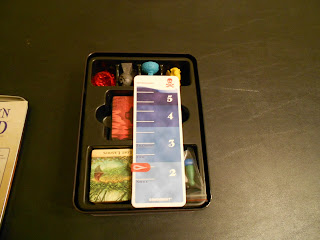 |
| What you get in the F.I. box |
Will you like these games?
The only reason you wouldn’t like Forbidden Island is because you dislike co-operative games, or simpler games. If you like playing family friendly games, give it a shot. It’s also a nice break for college students.
Pandemic would be great for high-school or college students, as well as an adult game group. It can be played with the family, but older kids would be better.
Amusing Story about a Gameplay
There isn’t one defining moment in Pandemic for me. There have been a lot of tight games, but I can’t recall a particularly memorable one. Forbidden Island is another story. I once played a game where Fool’s Landing came up in the initial set of sinking tiles, and then I drew a first turn Water’s Rise, followed by turning over Fool’s Landing thus losing the game. For those of you who don’t know the game, Fool’s Landing is the tile that everyone has to get to at the end in order to win the game, so if it sinks completely, the game is over.
Final Thought
It’s hard work comparing two games at once, but I think the extra work was worth it. Let me know what you think.
Want to buy Forbidden Island or Pandemic and support BoBG?
 Can't Stop is a great push your luck dice game. It fell on my list because I haven't played it in over a year. I don't own it, so it's not really under my control. The design is simple and straight forward, but I love the anticipation that each die roll brings.
 Kingsburg moves up due to more experience with the expansion. The game really offers a lot of choice, even with limited dice rolls. Yes, you can get messed over by terrible dice rolls all game long, but for the most part, you'll be able to do something on each turn. The more I play Kingsburg, the more I realize the depth in the game, and the different paths to victory.
 Fleet is still a really really good game, but I need to expansion to keep it fresh. The game has become a bit samey to me. I don't think there's necessarily one dominant path to victory, but there are several key things that you need to do in order to succeed, and once you get those things together, you're really hard to stop. I know that the expansion is going to change a lot of things, or at least add a lot of options, which will prevent some of those main paths. I enjoy Fleet, especially with new players, but in order for the game to stay up here again, I need the expansion to be excellent.
 I received Takenoko from my BGG Secret Santa, meaning I haven't had it long. The first time I played the game, I really enjoyed it. Every time I've played it subsequent to that, I've enjoyed it. That level of enjoyment demands a place on this list. I'm not sure where Takenoko will settle, but this seemed like a good place to start. Takenoko is a very approachable game that starts off simple and gets more complex as you go along. There are 5 options on any given turn, and you get to do 2, so you're not overwhelmed with choice, but you're also not too limited. I really enjoy how everyone has to interact on the board, but everyone has their own goals.
  If you read my review of Eight-Minute Empire you'd know that I enjoy the game, even though the title is a bit of a misnomer. This game is more like 15-20 minute empire. Still, it's a very well designed game, and it works well in a short amount of time. The game has two ways to score points, but they're directly related. On your turn, you purchase a card that has a symbol on it, and then you do the action listed on the card. At the end of the game you get points for sets of symbols, as well as points for areas controlled on the board. It's a really tight game with several key decisions, but it's also over quickly, so one bad move doesn't leave you losing for hours.
 Spoiler alert, Forbidden Island is gone, and Forbidden Desert has taken over. Forbidden Desert isn't the most challenging co-op game, but is by no means easy. The player powers are easy to understand, but making the best use of the combination in any given game is a true challenge. Make no mistake, Forbidden Desert is a lot more difficult than Forbidden Island. Sun beating down on the players will account for a lot of lost games.
 Small World is still a very enjoyable game for me. I enjoy the variety of races and powers. I also enjoy the player politicking that goes on to try to cut down the leader. The only reason it dropped a bit was due to newer games taking higher spots. Small World is a great game for Risk players looking for something a little shorter and something with a lot more variety.
 Moving down due to lack of plays and a lack of desire to play. Don't get me wrong, Dixit is still an excellent party game, and my go to game for a very creative group. The problem is that I don't have the creative mix of people that I had in college. Dixit truly takes a group of diverse thinkers to make it work as well as it can. That's one of the things that makes it a great party game. It serves as a way to get to know someone, but more importantly, learn how they think, and also discover some of the random connections that people have.
 Pandemic is an enjoyable game for me, but it moved down because the newest expansion essentially requires the new version of the game, and I'm really opposed to that. Now, I still enjoy what I have, and I will happily play Pandemic with what I have. The game is fine, but it gets a bit samey after awhile. My plays of it have drastically decreased over the last couple of years. It can suffer from one player telling others what to do. Fortunately, in my group, there are two of us who offer opinions and then leave the final choice up to the player. That system has worked well for us, though it's not perfect by any means.