Showing posts with label guest author. Show all posts

Friday, January 17, 2014

My Sister's Top 25 games of all time as of January 2014 Part 1 Intro and 25-16

Welcome to Sarah's Top 25 games.  I asked her to put together a list of the games she enjoys playing in order to give you guys a different perspective.  I had no influence on her list other than providing her a list of games and letting her decide how to order them.

Without further ado, the games!

#25 Fluxx

I like Fluxx because the rules change so much. It is fun to have to adapt and you never know what is going to happen. There are several themes, and it is fun to mix the regular cards with the Camelot cards. A game can last over an hour, which is annoying at times, but it is fun to play every once in awhile.

#24 Phase 10

I know this would not be on many gamers' lists, but I like when the players get to choose the order of phases they want to accomplish. It is a good card game to play, that people of all ages can enjoy. It is nice to play when you do not want to play a heavy-strategic game.


#23 Love Letter

This is a quick game and is a good balance between luck and strategy. It takes a few game plays to figure out how to best play which cards, but it is one of those games that can always be around to fill a void between longer games.


#22 Crappy Birthday 

I like this as a different game to Apples to Apples. It is a similar concept, but more fun and provides for some good discussions. I also like that there are pictures on the cards.


#21 Mille Bornes 

I have been playing this game for over 10 years, so it is on my list because it has become a tradition to play. You have to really pace yourself at this game, because if you try to finish too fast, the other players will give you trouble.


#20 Werewolf 

I like Werewolf when there is a large group of people. I'm never a special character, which bugs me, but I still have a good time, even though people are suspicious of me because I am quiet.


#19 Tiki Topple

Tiki is a good, quick game which allows for balanced scoring, most of the time. A person can rarely win every round and it is fun when it is a close game to the end. It is also fun to try and pronounce the names of the tiki pieces. I hope one day to play this while vacationing on some exotic island, but I will probably have to settle for Hawaii.

#18 Fauna

Fauna is a great educational game and it is a good trivia-like game for those not into trivia. Who wouldn't want to try to guess where the Pronghorn lives and how long its tail is?

#17 Word on the Street  

I like Word on the Street because you have to think quick. It is much better when you play with at least two people on a team, but it also works for one-versus-one. The game is good and subject cards are of a good variety, so it balances out the teams and puts everyone on a pretty even playing field. If you plan to play this game, make sure to do some research or brainstorming before, so you can increase the odds of winning.

#16 Incan Gold  

I like the risk aspect to Incan Gold. Sometimes the cards are gracious and give out lots of gold, but sometimes the round can end in 5 drawn cards. I tend to press my luck a bit too much, but that's the price for treasure hunting. Watch out for those spiders and mummies!


Sunday, December 15, 2013

The Best and Worst Games Played for the First Time in 2013

As I mentioned in a previous post, I put up the opportunity to guest write a post in the Jack Vasel Memorial Fund Auction on BGG.  Chaz Marler won one of the two opportunities  Chaz runs his own board game website/blog thingie at PairOfDiceParadise.com.  If you like what he has to say in this post, please go check out his blog.  We corresponded for a couple of days in early December to figure out what we wanted to talk about.  Eventually we decided on a best and worst games played for the first time in 2013 article.  This has a bit of back and forth with each of us talking about our games, then critiquing the other, and finally offering a rebuttal to any critique.  I hope you enjoy.

Chaz: Best Game that I played for the first time in 2013: Suburbia
It’s difficult to talk about Suburbia without making comparisons to the computer game Sim City. Both allow players to experience the nerve-wracking glory of building a city from the ground up, overseeing the growth of residential, industrial and commercial zones while balancing your city’s income, taxes and population. But while Sim City requires a computer to run it, Suburbia just needs… well, it just needs a copy of the board game Suburbia.

Now, I’ll confess that I’m a sucker for games with lots of pretty plastic pieces, which Suburbia lacks. That’s why, as a “Component Proponent”, I initially thought that I wouldn’t enjoy this game very much. It’s a bit bland to look at. However, its gameplay more than makes up for it. The game pulled me in quickly, and I forgot about the lack of eye candy after just a few turns.

Suburbia’s gameplay can be a bit technical at times. Things to mange and cross-reference can start to accumulate on your turn. But, in my experience, this still doesn’t diminish how enjoyable and rewarding it is to play. How enjoyable? Enjoyable enough to be my pick for the best new game I played in 2013.
- - - - - - - - - - - - - - - - - - - - - - - - - - - - - - - - - - - - - - - - - - - - - - - - - - - - - - - - - - - - - - - - - - - - - - 
BoBG response: I had a chance to play this game in January, and I really enjoyed it.  I do agree with you that the components aren’t over the top, but everything is high quality and functional.  I haven’t played much Sim City, but I do see the comparison.  Suburbia is in my top 5 games played for the first time in 2013, so I completely agree with the choice.
- - - - - - - - - - - - - - - - - - - - - - - - - - - - - - - - - - - - - - - - - - - - - - - - - - - - - - - - - - - - - - - - - - - - - - 
Chaz's final thought: Awright! I picked the only game of the four that we both played this year! I think that means I win this article. What's that? This wasn't a competition? Well played, Montgomery. Well played...

- - - - - - - - - - - - - - - - - - - - - - - - - - - - - - - - - - - - - - - - - - - - - - - - - - - - - - - - - - - - - - - - - - - - - - 

BoBG: Best Game that I played for the first time in 2013: Star Trek: Attack Wing

I came to the game with mixed anticipation.  I knew it had potential with the Flightpath system, but I was weary of bringing in bigger ships to that system.  After playing my first 3 games, I was sold on the whole thing, and it’s turned out to be one of my favorite games, not only of 2013, but of all time.  I really enjoy the ability to mix crews and factions to make interesting fleets.  The organized play system is incredible for fans.  Really, the whole game feels like it’s paying homage to Star Trek fans.  
- - - - - - - - - - - - - - - - - - - - - - - - - - - - - - - - - - - - - - - - - - - - - - - - - - - - - - - - - - - - - - - - - - - - - - 
Chaz's response: Oh-ho-ho, I'm jealous! Attack Wing looks really fun - in a strange way it reminds me of another game I grew up playing: Battletech. I've considered investing in this game more than once, but, so far, my wallet has been uncooperative. So, I gotta know, why did you chose this over Star Wars: X-Wing? Was there a rules variant you liked better in the Star Trek version? Prefer the Trek ship miniatures? Still bitter over that Greedo shooting first thing?
- - - - - - - - - - - - - - - - - - - - - - - - - - - - - - - - - - - - - - - - - - - - - - - - - - - - - - - - - - - - - - - - - - - - - - 
BoBGs final thought: I actually got to play X-Wing back in 2012.  The systems are similar, and I've invested into both.  As for which I prefer, well, you'll just have to stay tuned to my top games list in January.  Star Trek was my first sci-fi love.  It captured my imagination, and I really enjoy the whole universe.

- - - - - - - - - - - - - - - - - - - - - - - - - - - - - - - - - - - - - - - - - - - - - - - - - - - - - - - - - - - - - - - - - - - - - - 

Chaz: Worst Game that I played for the first time in 2013: The Lord of the Rings Dice Building Game
Several years ago, a game named Quarriors was released. It was a new twist on the deck-building genre, in that the players accumulated dice instead of cards. I haven’t had a chance to play Quarriors, but the idea of a dice-building game intrigues me. So, when The Lord of the Rings Dice Building Game (or “LOTRDBG” because I’m too lazy to ever type that long title ever again) came along, I thought it would serve as a great introduction to the dice-building genre.

But no, I was wrong. So very wrong. And I was severely punished for my mistake. 

I’m sure there’s probably a fun game in there somewhere, but I fear I’ll never find it because LOTRDBG’s rulebook is nigh-incomprehensible. I can only assume it was written by someone who hates information. 

The rulebook also makes repeated references to the game Quarriors. It assumes that the reader is familiar with that other game, and that for some reason knowing the differences between the two are paramount to your understanding of this one. At first blush, riddling one game’s instructions with references to another one may seem unnecessary and even confusing; like making UpWords anecdotes while teaching someone how to play Scrabble. 

But I think it’s brilliant! In fact, I’ve started randomly throwing out references to other somewhat related things whenever I’m teaching anything to anyone. While teaching my daughter how to tie her shoelaces, I peppered her with facts about velcro and buckle fasteners. Sure, she eventually decided to just go barefoot, but think of all the trivia she now knows about footwear she’s never worn.

Eventually, a slightly more comprehensible rulebook for the game was published on BoardGameGeek.com, but I’m still too shell shocked by the first one to attempt trying to learn this game again.
- - - - - - - - - - - - - - - - - - - - - - - - - - - - - - - - - - - - - - - - - - - - - - - - - - - - - - - - - - - - - - - - - - - - - - 
BoBG's response: I haven’t had a chance to play this game, but I have played Quarriors.  From your description, I can’t imagine trying to learn this game from the rulebook.  I think it’s poor quality control, and general laziness to cite from other games that people may or may not be familiar with.  I don’t know if this is the worst, but it certainly sounds like a terrible experience and one that would turn me completely off of a game.
- - - - - - - - - - - - - - - - - - - - - - - - - - - - - - - - - - - - - - - - - - - - - - - - - - - - - - - - - - - - - - - - - - - - - - 
Chaz's final thoughts: I agree, because the experience has prevented me from taking the plunge into regular Quarriors. Every time I'm about to buy a copy, I'm revisited by the specter of LOTRDBG. Plus, I also have to stop and ask myself, "Do I really need another dice game? Don't I already have enough dice?" (Spoiler alert: The answer is no, you do not already have enough dice. One can never have too many dice. I am unsure how the human mind could even form such an absurd question. *shudder*)

- - - - - - - - - - - - - - - - - - - - - - - - - - - - - - - - - - - - - - - - - - - - - - - - - - - - - - - - - - - - - - - - - - - - - - 

BoBG: Worst Game that I played for the first time in 2013: Ace of Spies
I backed it on Kickstarter, and I really thought it had potential.  The game just feels lifeless to me.  I’m collections and playing a bunch of cards.  There’s very little tension to the game, outside of wondering what terrible thing your opponent might do to you next.  The game is far too long for what it is, and on top of that, it isn’t engaging.  Ace of Spies took a wonderful theme and turned it into a snoozefest.
- - - - - - - - - - - - - - - - - - - - - - - - - - - - - - - - - - - - - - - - - - - - - - - - - - - - - - - - - - - - - - - - - - - - - - 
Chaz's response: Aw, that's disappointing to hear. I missed out on this game's kickstarter, so I haven't had a chance to play it, but it did look intriguing. From what I've heard about how the game plays, it sounds like it may be one of those where the enjoyment level may hinge on the personality type of the people you play it with. Do you think that it would be a more enjoyable experience if you were to play it against a different opponent? 
- - - - - - - - - - - - - - - - - - - - - - - - - - - - - - - - - - - - - - - - - - - - - - - - - - - - - - - - - - - - - - - - - - - - - - 
BoBG's final thought: It could be the people I played with.  I think it has potential with a different group, but groups don't change the mechanics.  I have only played this once, so I'm willing to give it another shot.
- - - - - - - - - - - - - - - - - - - - - - - - - - - - - - - - - - - - - - - - - - - - - - - - - - - - - - - - - - - - - - - - - - - - - - 

So folks, there you have it.  Those are some thoughts on some of the good and bad games Chaz and I played for the first time in 2013.  I wish we had a little bit more back and forth, like one of us hating a game that the other loved or vice versa, but I still think this is a quality article.  Big thanks to Chaz for donating to the Jack Vasel Memorial Fund and for coming up with a great article topic.  

Monday, October 8, 2012

Money, Money, Money! Review

Money!
  • Designed by Reiner Knizia
  • Published by Gryphon Games
  • 3-5 Players 
  • Plays in around 30 minutes
For this review, I asked my friend Rose to write her thoughts on the game.  I've played Money!, but not nearly as much as she has. Ergo, I felt she was better suited to giving a review than I was.


Overview
Give away money to try to get more money! Try to collect entire currencies for the most points.

Components
A look inside the box.
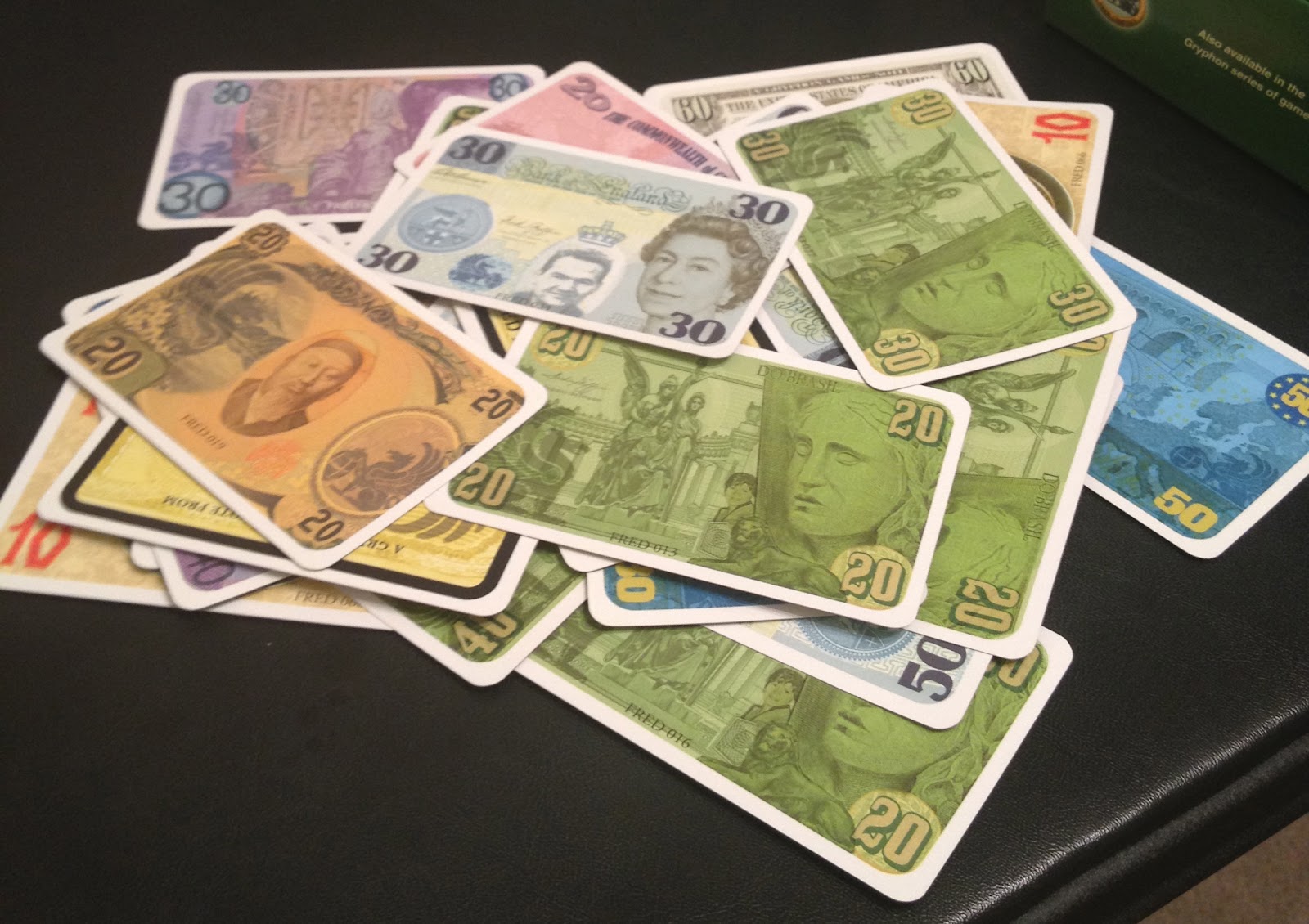
Money is a pure card game; it comes with 69 currency cards and 5 bluff cards. The cards are sturdy and attractive; all currencies but one are close replications of actual real-world currencies (US dollars, Australian dollars, yen, pounds, Euros, etc.). The cards are a bit large, which can make holding them all difficult as your hand swells, but that is my only complaint.

Mechanics
Each turn, two sets of four cards are laid out. You place cards from your hand face-down to bid on the available cards. The person with the highest bid gets the first choice and exchanges the cards they bid for the set of cards they want, second highest bid gets the second choice, etc.

The goal of this is to get the most possible points. You get points by having complete/near-complete sets of currency (three 20s, three 30s, one 40, one 50, and one 60). 

All of the green currency cards
The rules for scoring are somewhat complicated. At the base, cards are worth their face value. The 20s and 30s, if you have all three, are worth an extra 100 points each, making the three 20s worth 160 points and the three 30s worth 190 points. These, plus the 40, 50, and 60, make a possible total of 500 points for a complete currency. However, if you have incomplete sets of currency, it gets more complex. If you have over 200 points in face value of the cards alone, you get the face value. If you have less than 200 in card face value, you get the face value of the cards minus 100. The bonuses for the sets of three are added in after these calculations. If the total is less than 100, the cards are worth nothing, but there is no penalty. Additionally, there are six Chinese coin cards, each of which is always worth 10 points, no matter how many of them you have.

Interaction
The main interaction in Money is trying to figure out how much other people are bidding and how badly you want to beat them for a particular set of cards. Because the bids are placed face-down, all you have to go on is the number of cards placed. The actual value could range from 60 to nothing, since each player has a bluff card they can use to “pad out” their bid to make it look bigger, or pass on a given hand entirely.

Theme
International currency! The theme is the driving force of this game, and as such it works very well.

One of each type of currency card
Learning Curve
Medium. It takes a playthrough or two to get the hang of how the strategy of the game works.

Why I like Money
I like the bidding mechanism; the only other games I've played with bidding were bridge when I was a kid and Monopoly (which was actually my favorite part of Monopoly). It's complex enough that it stays interesting, and there is some skill and strategy involved, but there is a certain amount of dumb luck, which means it's not overly intellectual.

Why I don't like Money
Nice big pile of Money!
The scoring is somewhat complicated, and with the physical version, it's hard to tell which set of cards will increase your score more (there's a version for the iPod/iPhone/iPad where it tells you what a set of cards will do for your score). As I mentioned, the cards are a little big, which can get cumbersome.

Replayability
Very replayable. I usually play at least three games in a row.

Overall 
Money is a fun, quick game. Once you get the hang of the scoring, it's not very complicated, but it's not simple enough to get boring quickly either. I'd give it one thumbs up.

What else is like Money?
Bridge is the closest relative I can think of, but it's a fairly distant cousin on the family tree.

Want to buy Money and support BoBG?


Monday, May 14, 2012

Magic: Cost, Fun, and Balance


Back in the April Update I offered that anyone could take some time and talk about something related to gaming. One of my friends, Chris, took me up on the offer.  Chris and I played games in college, but he has a fairly different gaming history than I do.  I won't spoil too much, just know that his words are well thought out, and unedited.
A couple of weeks ago, David and I were talking about games and other stuff when I suggested to him that it might be fun to hear from people who play tabletop-style games other than boardgames.  To my surprise, he remembered that I have played Magic: The Gathering for some years now and invited me to write a guest post on trading/collectible card games (TCG/CCGs).  Since Magic is pretty much the only TCG I’ve played I’ll write about that, but I’ll try to make general comments about the genre and relate the discussion back to the theme of BoBG, namely boardgames.
For those unfamiliar with Magic, it is a collectible/trading card game published by Wizards of the Coast.  The premise is that two (or more) players take on the role of dueling “Planeswalkers,” drawing on the land to cast spells represented by the cards in their decks.  The last Planeswalker to avoid exhausting either lifepoints or cards in their deck wins.  So far, except for the mention of decks this could describe any boardgame just as well as a TCG.  The obvious difference in the two genres comes from the fact that boardgames are typically completely encapsulated in one package, whereas TCGs are purchased in packs containing quasi-randomly distributed cards.  The consequence of this game model is that, relative to the boardgames I have played, Magic (and I suspect most all TCGs) features far more dynamic gameplay.  
What I mean is that since the game designers don’t know what elements will be present in any given game, the cards in the game establish many of the rules.  Some readers may be thinking of Cosmic Encounter at this point, and for good reason; Cosmic was one of the major inspirations for Magic.  However, Magic goes further than Cosmic in that the entire setup of the battlefield will change over the course of a game of Magic, whereas the landscape is essentially set at the beginning of a game of Cosmic.  To prevent a game of Magic from changing uncontrollably quickly, players are given a lot of freedom to interrupt each other and a player’s turn is therefore far less sacrosanct than in a boardgame, which tends to induce a lot more player interaction.  Control of the way the game changes and hampering opponents’ actions (two sides of the same coin) are therefore really the heart of the mechanics of Magic.
Now, while this setup makes for some of the most enjoyable gameplay I’ve experienced, it has some rather deep pitfalls.  The first is that, to be quite honest, Magic is an expensive hobby.  Coming in at about $4 per 15-card pack, it takes a moderate amount of money to build up a collection of decent cards.  Singles can be purchased, but they are typically more expensive for the good cards.  To make matters worse, about once every two years all the cards currently on the market cease to be tournament-legal.  That means that a player is either reduced to playing informally with friends or must start over and build a new collection (one reason, I suspect, that people sometimes refer to the publishers as “Wizards of the Cost”).  I personally never play in tournaments for this reason and because I like to play with many of the old cards, but this cuts me off from a lot of the Magic-playing community.  This also explains why I have only ever played Magic among all the TCGs out there: it is simply too expensive to purchase the cards needed to play multiple systems.  
The other major downside to Magic is that it is pretty complicated.  There are quite literally hundreds (if not thousands) of rulings to pore over if a player wants to learn the nuances of the game, and every expansion adds more to the mix.  This means that a new player must invest a substantial amount of time in achieving fluency in the game mechanics in order to construct a superior deck.  Achieving a sufficiently wide knowledge of cards is also necessary to understand what is possible.  These are significant barriers to TCGs in general and I suspect commonly prevent people from playing these games.
What may surprise some people is that I actually like almost everything I’ve written here about Magic (except for the price).  I like learning complicated systems, and I like that the strategy of Magic relies on both constructing a good deck and having a deep knowledge of the rules.  Many times I have seen a bleak situation turned into a win and vice versa by knowing (or not knowing) the details of a specific rule.  That strategy and knowledge goes into building a deck before ever playing, and the creativity it allows is incredibly satisfying.  
For better or for worse, this becomes the standard against which I often judge other games I play, including boardgames.  Often when I find myself consistently unable to meddle with my opponents’ plans my enthusiasm for a game begins to cool.  Similarly, when I begin to perceive that a game doesn’t allow for innovative ways to achieve my ends, I find my interest waning.  David once quipped that I never win at Cosmic, and he’s right, but that’s because at some point I start to grow disinterested in merely winning: I want to find out just how many ways it is possible to win.  Often enough my strategies fail, but if I get to try something new then it’s enough for me.  Are there other mechanics that make it fun to play games?  Certainly; finding traitors in one’s midst (a la Mafia/Werewolf) is a good example, but even without these mechanics I will happily keep coming back for more as long as a game continues to let me innovate.
I think this is a good point to wrap things up since this post has already become longer than I had intended it to be.  Clearly I cannot convey the actual experience of playing Magic here, but I hope that anyone reading this has at least found some interest in seeing boardgames through the eyes of someone who primarily has played TCGs.  Big thanks to David for letting me ramble on his blog, and happy gaming.

Thank-you Chris for taking the time to write thoughtfully about an often debated topic in the gaming world.