Showing posts with label Review. Show all posts

Sunday, December 22, 2013

Mystery of the Abbey Review

Mystery of the Abbey
  • Designed by Bruno Faidutti and Serge Laget
  • Published by Days of Wonder
  • For 3-6 players, ages 10+ though I recommend 4 or 5 player games.
  • Playtime is around 2 hours, though I've seen a 75 minute game and a 2.5 hour game recently.
Catch
Take the classic game Clue, add controlled movement, add a lot more options, and you have Mystery of the Abbey.  Basically, MotA is Clue on steroids.

Mechanics
In Mystery of the Abbey, players are trying to figure out which monk card is missing from the game.  Each monk has several characteristics, their order, their position, if they have a beard or clean-shaven, if they're hooded or unhooded, and if they're skinny or obtuse.  Players start with a hand of monks which they can rule out as suspects, and they gain more knowledge by taking actions.
On a turn, players move 1 or 2 spaces, and may perform the action of the room they're in.  If they end their movement on the same space as another player, they must ask them a question.  The other player then has two options, they may either answer honestly, and then ask the first player a question, or they may take a vow of silence and not ask a question.  After each player takes 4 turns, then all players return to the chapel for mass which involves passing cards and some kind of event.  Figuring out what to ask, and when to answer questions other players ask is a key to this game.  The first player to figure out who the murderer is, and get to a specific location, gets 4 points.  There are other ways to get points in the game, but most often, the player to figure out the murderer will be the winner.

Interaction
Questioning and listening is a huge part of this game.  Questions are very interactive, while listening is very passive, but both are very crucial aspects of the interaction in MotA.  This game requires player interaction, else it becomes a very tedious exercise in luck.

Theme
The abbey theme comes through with a lot of flavor text on the library cards.  I like the way the theme is incorporated with the mechanics, but the game could have a completely different theme and still play the same.  Nevertheless, the theme is good, especially for a family game.

Components
The game has a bell!  See, I like random cool components that actually serve a game purpose, and the bell here fits the bill.  Player pawns are well done, the custom dice work well, and all the cards are good quality.  The rules are well written with plenty of examples to help new players learn and people who haven't played in a long time refresh their memory.

Learning Curve
Mystery of the Abbey takes a game to have a sense of what to ask and when to answer questions, as well as have some idea about why other people are asking what they're asking.  It's certainly a game that anyone can win their first time, especially if they enjoy the deduction in Clue, but it is not an easy game.
A Crypt card that players can get
from the crypta in order to take
an extra turn later in the game.

Replayability
I've gone in spurts with MotA.  I don't play it all that often, and I think that I'd get tired of it if I did.  That's my personal taste in frequency, but the game is highly replayable.  Sure, it is essentially the same problem every time, but there's a lot of different ways to solve the problem, and the clues are different, so the game feels different every time you play.  I suppose once people really know the game, they will play the same way every time, but I haven't gotten anywhere close to that yet.

Why I like Mystery of the Abbey
Sample Mass card
This one is for round 6
I liked Clue growing up, it's probably the most mainstream game that I'd be willing to play right now.  MotA takes the things that I like about Clue and refines it, and adds in different options that make the game very enjoyable.  It's a process to try to win, but it's one of those games where I don't really care if I win or not, because the process has been enjoyable.

Why I don't like Mystery of the Abbey
MotA is a bit long for what it is.  I've taken to using some of the speed up variants in the rules, because they eliminate the tedious, and add to the fun part of the game.  Even with those, the game can be long.  It really depends on the other players though.  Certain players will make this game a blast, while others can make it really tedious.


Overall
The player aid and suspect sheet hiding device.
I like Mystery of the Abbey.  I enjoy playing it.  I don't think it's the best game out there.  I like it more today than I did last year because I had a chance to play it with a fresh perspective.  MotA isn't a game I'm going to pull out all the time, it's maybe a 2-3 times a year game, if that.  If you enjoy deduction games, this is certainly one of the better ones out there.
Suspect sheet
It says something when a game that originally came out in 1995 is still around today and worth talking about.

Would it be a good game for Tabletop?
No. Mystery of the Abbey really rewards players who know how to play the game well when it comes to questions, and I think this would be hard to watch and understand what's going on for someone who didn't already know the game.

Monday, November 25, 2013

"Live Long and Prosper" - A Review of Star Trek Attack Wing

Star Trek Attack Wing Miniatures Game
  • Designed by Andrew Parks and Christopher Guild
  • Published by WizKids Games with the flightpath license from FFG
  • For 2 players, but you can really play with any number, so long as the fleets are balanced.
  • Playtime depends on what you're doing, most core set matches will take 45 minutes, larger games run longer, it depends on how large you make it. Figure 60-90 minutes for most matches.  Organized play is exactly 60 minutes.

Overview
Part of my painted fleet
First off, this is a miniatures game, but don't let that scare you off.  Attack Wing plays a lot more like a board game than a traditional miniatures game.  That being said, if you get into this game, you will spend money buying expansion ships.
Players make moves, take actions, fly around in space, all with the goal of shooting the other guy down in flames.  It may not be an accurate space combat simulation, it may not even feel accurate to Star Trek, but it is an engaging experience.

Review Note: I have a whole lot of ships, so it's almost impossible for me to discuss only the core set.

Components
I have everything organized in a Plano 5231
Core Set: 3 ships (1 Federation, 1 Klingon and 1 Romulan), and all the components you need to actually play the game.  This includes movement markers, special tokens, attack and defense dice, ship cards, and a few upgrades.
Each Expansion: 1 Ship, a movement dial, 1 or 2 special captains, some upgrade cards, assorted tokens. For instance, the Defiant expansion comes with most of the main federation characters from Deep Space 9.
Quality wise, all the tokens are good to great, while the cards are ok.  I have all my cards sleeved to protect them, and give them a little added rigidity.

Mechanics
A Federation and
Romulan logjam.
Here's how turns work. All players select a movement on a movement dial for each of their ships.  Starting with the lowest captain skill and going up, players reveal their move, use the movement guide to execute the maneuver, and then select an action to perform.  After all ships have moved, the highest captain skill, and going down, makes an attack if they can.  Attacking is simple, roll dice equal to your attack value, 1 extra if you're at close range, while the defense rolls defense dice equal to their defense value, 1 extra if they're at far range.  If the attacker rolls more hits than the defense can evade, the defending ship suffers damage equal to the non-evaded hits.  When you've taken damage equal to your hull rating, your ship goes boom.

The game offers a handful of scenarios, which I've yet to try.  I've been playing last man standing, and the Organized Play campaign, which I'll talk about shortly.

Interaction
A close up of Picard in
command of the Defiant
Attack Wing is full of interaction.  It's a game of out-thinking your opponent, trying to get the tactical edge, and exploit it.  It's a little slow at first, but the game quickly picks up and turns into a knock-down, drag-out fight.

Theme
Attack Wing is Star Trek combat.  It is far from perfect, but it is easy to play.  Each captain brings their own unique ability, and each ship has its own unique ability, so it seems to work well.  The game mostly makes logical sense, aside from a full stop move.  The game does allow for some weird stuff, like being able to assign Captain Picard to a Dominion or Romulan ship, but that caries an added point cost for your squadron.

Learning Curve
The difference some paint makes.
Left is out of the box,
Right is after a base coat of grey,
a wash, and some custom touches
There's a medium learning curve.  There are intro rules, but they are very basic.  Still, if you've never played advanced boardgames, the intro rules give you a great jumping in point.  The full rulebook is involved.  There are a lot of things to understand, so it's best to take it step by step.  It may take a couple of games to start to understand what's going on, but you'll get there.  After you understand the core concepts, you still have squad building to work through, which can take a good deal of time.

Why I like Attack Wing
I've played X-Wing, and I love Star Trek.  I was skeptical for a long time about getting into another minis game, but the support from WizKids and the variety of ships have tipped me over.  The game is easy to get into, but also very challenging to master.

Why I don't like Attack Wing
Price point.  Core sets are reasonable, ~$25 online for 3 ships plus a whole lot of cardboard isn't bad at all.  After that though, each miniature is $10-$12 online, $15 MSRP.  Now, I know that hand-painted minis are pricy, but it can get expensive to have a large game, particularly if you don't have fellow players investing.  I'm currently in this game for around $200 with another $40+ every two months for new ships.

Organized Play
I've added this section for Attack Wing because it's worth talking about.  WizKids started this game off with a bang.  A 6 month campaign focusing on 6 of the biggest moments in the Dominion War from DS9.  Each month you get something just for showing up to your local store.  If you win, or get the fellowship prize, you get an exclusive ship with some new captains and various upgrade cards.  At the end of the 6 months, the overall winner takes home a "mini" Deep Space 9 which is over a foot in diameter.  They've also announced a couple of one-off events focusing around the Tholians and Gorn episodes from TOS, as well as a "Resistance is Futile" campaign which means Borg.

Replayability
Showing what a black wash can do
Depends on what you have.  The core set offers 3 scenarios, plus dogfighting and some customization with captains, crew, and various other upgrades.  This is a great amount if you play it as a 2 or 3 player game and just as an occasional Star Trek fix.
Once you add in extra ships, the replayability grows exponentially.  First, you'll want to play more often because the game just feels that awesome. Secondly, there are new challenges with fleet construction and point matches to keep things interesting for a long time.

Overall
The rest of my Federation fleet
and a comparison between
boxed Defiant (R) and painted (L)
I think Star Trek Attack Wing is a good design.  It uses the Star Trek license to full effect and has me, and many others, eagerly anticipating future ships.  It built on a solid set of mechanics using the Flight Path system.  The models are ok, they really need at least a wash, probably a full paint to really look good.  The gameplay is solid, though a bit random at times.  The game plays quickly, but allows for longer matches if players desire.  It really is flexible to whatever you're looking to get out of a skirmish game.  Ships die quickly in this game, which can be both good and bad depending on what you're looking for.
Box (L) and washed and painted (R)

Also, the future is bright with this game.  As of posting, there are 12 expansion ships, plus the 3 in the core set released.  There have been 3 months of Organized Play adding an additional 3 ships.  4 more ships are scheduled to come out in early December, 4 more in February, and 4 more in April.


Friday, November 15, 2013

Article 27 Review

Article 27: The UN Security Council Game
  • Designed by Dan Baden
  • Published by Stronghold Gales
  • For 3-6 players, ages 10+ though I recommend 4 or 5 player games, with the occasional 6.
  • Playtime is around 7 minutes per player. (5 for each negotiation round plus bookkeeping)
Catch
Have you ever wanted to find out how you'd do in international politics?  Do you think you can convince your friends to do what you want even if it's not in their best interest?  Do you like negotiation and frantic back and forth?  If you answered yes to any of these questions, then Article 27 just might be the game you're looking for.

Mechanics
Player board after drawing issue tokens for the round.
At the start of the game, each player is given a secret objective such as Power or Social Justice.  At the end, that objective will score points based on how many times it is part of a successful bill during the game.  In each round, one player is the Secretary General, which means they are in charge of crafting a bill and maintaining order to some degree.  Each player will draw 5 tokens and place them (in order) on their player board.  If the color is part of a successful bill, then the player will gain, or lose, points based on the position.  Once all players have drawn their tokens, the Secretary General places an bill on the table, bangs the gavel, and starts a 5 minute timer.

Most of the components in the game.
This is were the madness kicks in.  Players have at most 5 minutes to bribe others to do what they want.  Some bribes can be simple, such as, "I'll pay you 1 to put red in the bill." or "I'll pay you two to take blue out."  Other bribes can get much more complicated like "I'll pay you 4 to put yellow and blue in, take green out, and you only get it if the bill passes."  Typically the complex bribes don't work, but they can be worth trying.  Only the Secretary General may alter the bill, so those are all examples of a bribe to the SG.  A player could bribe someone by saying "I'll pay you two to vote 'yes' on the bill." or even, "I'll pay you 2 to veto."  Your own creativity is your only limitation in how you bribe others.

The rest of the components in the game
At the end of 5 minutes, or when the Secretary General stops negotiations, all players vote on the bill.  A player has 3 options - 1) Approve 2) Abstain 3)Veto.  If any player vetoes, they pay 5, and the bill fails.  If there is no veto, then a majority of the table must approve in order for the bill to pass.  If a bill is approved, then the Secretary General takes 5 points, all players take points equal to the sum of their positive and negative tokens, and the issues that were part of the successful bill are placed face up in the proper row, while issues left on the table are placed face down.

This process repeats until every player has had a chance to be the Secretary General once, twice in a 3 player game.  Then players reveal their secret agenda, take points for it, and reveal their total score.  High score wins.

Interaction
The artwork on the 6 country boards
Since Article 27 is a negotiation game, there is a great deal of interaction. Most of the interaction is with the Secretary General, but when you get a bill you really like, you have to make sure that no one is going to veto it, so you have to gauge other players and perhaps bribe them to make that happen.  Article 27 is founded on negotiation and interaction.  Without it, the game is rather dull.

Theme
Article 27 does a decent job of incorporating it's theme into the game.  I rarely feel like I'm a country negotiating with other countries, but the theme is there for people who want it.  Some people will start talking in accents, which is often hilariously bad, but it adds to the game.

Components
The final issue board.
Money gets 3 points, Prestige gets 6 points,
Justice gets 10 points, Peace gets 6 points,
Innovation gets 6 points, and Power gets 6 points.
Very simple components here.  Everyone has an approve and reject token and 6 country tokens.  The issue tokens are well done, though white on yellow was not the best call, so I had my sister use a sharpie to outline the pictures.  The player boards are well designed, though I wish that the screens were less prone to coming undone.  All the components are good quality, the artwork is well done, even if not to everyone's taste.  The gavel sends it over the top though.  It has to be one of the better components in any game.

Learning Curve
I think that Article 27 is the kind of game where you need to play it, or at least see it played before you truly grasp what is going on.  It's not that the game is overly complicated, it's that the game has several things going on that everyone needs to track.  It helps immensely if someone has played it before.

Replayability
I've played Article 27 13 times in the past several months.  However, it's been played less often.  I'm always up for this, but not everyone else enjoys it.  I think that might be because you're essentially playing the same thing every time.  Sure the secret agendas change, and the way issues come up, and the tokens you draw, but really the game is fundamentally the same every time.  I don't think that being the same is a terrible thing, but I wonder how much more I can really play it.

Why I like Article 27
Negotiation is fun for me.  Having to compromise, yet knowing when to flex your veto muscle is a great challenge.  You have to read people, try to figure out who wants what, and you have to maximize your points.

Why I don't like Article 27
The lack of variety as mentioned in replayability doesn't help.  If people aren't engaged, the game can fall flat.  It does take a group who's willing to work together but also mess with each other to bring out the fun in the game.

Overall
A Screenshot of the free timer app from Stronghold Games.
It also makes gavel noises at the start as well as every minute.
I like Article 27, but I can't love it.  It's a solid game, but after the first 10 or so plays, the shine is gone.  I'll still play it any chance I get, but I'm not actively seeking it out.  If you're into negotiation, this is a great game to try.  I'm happy I own it, I think it fills that negotiation niche in my collection.  I'd love an expansion, but I have no idea what you'd do in an expansion for this game.
Would it be a good game for Tabletop?
Perhaps.  BGG's Gamenight played this, and I enjoyed watching that.  I'm not sure Tabletop would be right since they edit a lot for time.

Tuesday, October 8, 2013

Resistance: Avalon Review

Resistance: Avalon
  • Designed by Don Eskridge
  • Published by Indie Boards and Cards
  • For 5-10 players, ages 13+
  • Playtime is around 20 minutes.
Catch
You are a knight of the round table who is attempting to go on quests and figure out who the traitors are.  Unless you're a traitor, in which case you are trying to fail quests and place blame on others.  Avalon is a game of deduction and bluffing.  Evil is around you, and your job is to figure it out before the kingdom is lost forever.

Mechanics
There will be a mix of traitors and loyal knights at the round table.  How many depends on the number of players, but typically it's one less than half the group.  At the start of the game, everyone is given a role card.  There are some generic loyal and traitor knights, but there are also some special characters which I'll discuss in a bit.  Once everyone looks at their card, a player will conduct the opening of the game by having everyone put their heads down and then traitors will look up and see each other.  Then they go back to sleep, but they place a thumb up in the center of the table.  At this point, Merlin(a good guy) wakes up and sees who all the evil players are, but no one sees him.  (Various other characters can add to this, but I won't discuss them here.)

Then the game begins.  The starting player nominates the number of players for the first quest (this varies based on player count) and all knights vote to approve or reject the team.  Since this is the round table, everyone has an equal voice and majority rules.  If a team is rejected, then the crown passes to the next player who nominates a new team.  If a team is approved, then those players go on a quest.

Typical roles for a 5 player game
On a quest, each player is given a Success and a Fail card.  If a player is loyal, they MUST play success.  If a player is a traitor, they have the option of playing success (deep cover) or playing a fail.  These cards are placed in the center and mixed up.  If there is even one fail, the quest fails.  The only way to succeed is if all cards are a success.  This continues until one side has won 3 quests.

At this point you're thinking that this sounds pretty simple, and that Merlin has a huge advantage.  Well, you're right on both counts.  The counter to Merlin is that at the end of the game, if the loyal knights are victorious, then the traitors have a chance to assassinate Merlin.  If they guess correctly, then they win instead.  The counter to the game being simple is that player interaction makes the game insanely messy and complicated in a good way.

Interaction
Avalon is one of the, if not the best example of an interactive game.  Everyone knows a part of the puzzle.  Spies and Merlin know the whole thing, but they can't convey their knowledge without giving something away.  Every single action you perform in this game tells a little something about who you are.  Who you send on teams when you're the leader is vitally important, but so is the way you approve or reject teams.  Then there's the way you talk to other players.  There's a lot of group think, but you can never rely on it because you never know who's on your side.  I'm a very vocal player in this game, which is great when I'm Merlin or a spy, but terrible when I'm a normal good person.  Still, I have to be the same vocal person every time.  Because I'm very vocal, and because I'm a very logical thinker, I have a lot of persuasion power over people.  Someone once said I could convince a loyal knight that they were a traitor.  I don't think I can quite do that, but the idea is there.  I once gave a completely logical argument to Player A as to why I wasn't a spy and Player B was.  Player A believed me, and yes, you guessed it, I was a spy.  Those are the moments this game provides.

Theme
Avalon is reasonably themed.  I enjoy Arthurian lore, so the game is a fit for me.  This is a rethemed version, with additions, of The Resistance.  I bought the Resistance in 2012, and it fell flat.  It wasn't bad, but it just didn't grab anyone.  Avalon captured people's attention and imagination.  Having traitors in your midst provides tension to the game, but not so much that it makes people overly anxious.  I think the short playtime really helps with that balance.

Components
Pile of components in the game.
A lot in a small box.
Very simple components here.  Everyone has an approve and reject token, there are loyalty cards, boards for the different player counts, and success/fail tokens to mark the results of past quests.  They're all solid and functional components.  I am noticing some wear on my approve and reject tokens, but that's not a huge issue.

Learning Curve
I think that almost anyone could learn this game with just the rules, but it probably takes a play to see how things work.  For some it may take more to feel comfortable enough with all that's going on, and to play all the different roles, before they really grasp the game.

Replayability
I've already played 23 games in the 2 months or so that I've owned the game.  This almost always gets played at my biweekly Friday night gamenight, and we play at least 3 times.  I want to play this game even more than I already do.  There's something new every time I play, even when everyone has exactly the same roles they've already had.

Why I like Resistance: Avalon
This gives me a reason to flex my analytical muscle.  I love trying to figure out the puzzle.  It forces me to talk and organize things, but also to slide into the background at times.  I enjoy playing this game with any role, though Merlin is the most fun for me and loyal servant is the most challenging.

Why I don't like Resistance: Avalon
It really takes a group of people who are either comfortable with each other, or players who are willing to make wild accusations to keep the game interesting.  If everyone just does their own thing, the game can be boring.

All of the roles (From L to R, Top then Bottom)
Normal evil, Mordred, Assassin, Oberon, Morgana
Normal good x3, Percival, Merlin
Overall
If you couldn't tell from the above that I really really like this game, then you probably just skipped down here.  In all seriousness, this is a huge keeper for me, and it may do shocking things when my top games list comes out in January.

Some people call this a Werewolf/Mafia knockoff/clone/variant.  It's true to a very small extent, but here's why I like The Resistance better.  You don't need a moderator, which let's everyone play.  It also has no player elimination, which keeps everyone involved the entire time.  Sure, you can have a spy outed really early, but there's always the chance that they can try to work their way into good graces again, whereas in Mafia/Werewolf, once they're lynched they're gone forever.

Would it be a good game for Tabletop?
Sure, they already did normal Resistance, why not throw in Avalon?


Friday, September 20, 2013

TransAmerica Review


TransAmerica
  • Designed by Franz-Benno Delonge
  • Published by Rio Grande Games
  • For 2-6 players, ages 13+
  • Playtime is around 30 minutes.
Catch
Each player has 5 cities spread throughout the US.  Their goal is to be the first person to connect all 5 cities.  Players lay track on their own route but will eventually connect to other networks.

Mechanics
The city card shows where the
city is on the map
On your turn you place 2 points worth of track on your own network.  Most track pieces cost 1 point, but some cost 2. (crossing mountains and rivers)  Eventually you connect to other networks, and then you can place on those.  A round ends when one person has connected all 5 of their cities.  Other players lose points equal to the number of track points they would have to place to complete their route.  The game plays over multiple rounds until one person has lost 13+ points.  At that point the player with the most remaining points wins.

Interaction
Starting spots for a 3 player game
There is a good deal of interaction in TransAmerica.  A big key to the game is figuring out when to connect to someone else's network.  You also have to realize that every piece of track you lay down can help someone else, so you want to be careful about the areas you open up to others.  If you add in the Vexation expansion (included in the box) then the interaction ramps up.  Vexation adds 3 tracks in each player color.  These tracks serve as exclusive use tracks for that player and really alter the flow of the game.

Theme
TransAmerica doesn't have much of a theme.  There are wooden train pieces to mark player scores and the track pieces do give you a sense of a train theme.  Essentially there's a theme there, but it's not jumping out at you.  The lack of strong theme isn't a terrible thing since the game stands on its own.

Components
All the components in the game.
The components in TransAmerica are fairly basic.  There are plenty of track pieces, a starting marker for each player, and a score marker for each player.  There are also city cards for each city on the map, which are fairly small cards.  I normally despise small cards, but here they work fine.  I think it's because you're just holding them, there's no drawing from a deck or having to sort them, it's just 5 cards.

Learning Curve
TransAmerica takes a round to learn.  You're not really going to have a good sense of what to do the first time you play, but fortunately the game is played over several rounds.  It's one of the reasons why this is a great intro game.  Sure, one bad round can put you behind, but you're never completely out of the game.

Close-up of the score track and the trains on it.
It's an actual track.
Replayability
I've played TransAmerica 16 times in person and a bunch more online.  I still enjoy the game every time I play.  I do like to add in Vexation from time to time, just to add that extra strategic layer, but I still have fun with the base game.

Why I like TransAmerica
TransAmerica is simple to teach.  The sharing of track leads to a very relaxed game state that no one takes overly seriously.  There's enough strategy for gamers, but not so much that new players don't stand a chance.  It really is a game that just about anyone can play.

Why I don't like TransAmerica
If you have a player who doesn't like to think ahead, they can really slow the game down.  In addition, if someone starts connecting to cities that aren't their own, they can really skew the game towards someone other than themselves.  There are times where you know you can't win far before the game is ever over, which can be frustrating.

Overall
A sample end of round board with the vexation expansion
I like TransAmerica.  I think it is a good game to have in a collection.  It's not the most complex of games, but that's its charm.  The game works well with 2-6 players which is nice for those big groups.  The game has flaws, there's a fair bit of luck, but it isn't meant to be a super strategic game.  It's simpler than Ticket to Ride, so if you think Ticket is too simple, don't bother with this.  I like Ticket better, but I still think TransAmerica is worth owning.

Would it be a good game for Tabletop?
I don't think it would be bad for Tabletop, but I'm not sure that it would really be good.  It's less interesting to watch than Ticket to Ride, so I probably wouldn't bother with this.


Wednesday, September 4, 2013

Hanabi Review

Hanabi
  • Designed by Antoine Bauza
  • Published by R&R Games
  • For 2-5 players, ages 8+, though I'd argue for 10+
  • Playtime is 30 minutes.
Catch
Players are working together to play cards in order, but you can't see your own cards.

Sample of the different cards
Mechanics
On your turn, you have 3 options.  1) Play a card. Probably not a good thing to do blindly.
2) Spend a token to tell someone something about their hand.  You can tell someone all the cards of a single number (1,2,3,4,5) or all the cards of a single color (red, yellow, green, blue, white).  3) Discard a card from your hand and gain a token.
While each turn seems fairly simple, they really aren't.  There's a lot going on in the game, and each person needs to know things.  The mechanics are simple, but there is a lot of depth in the game.

The Fuse(L) and Clue(R) tokens
Interaction
There is a good deal of interaction is Hanabi.  You're trying to figure out your own cards by the clues people give you, but you're also trying to figure out the best clues to give to other players, as well as figure out who needs to know something right now and who can wait for a bit.  The game does get a bit thinky, so some players will retreat to their own thoughts, but each clue can really tell you a lot about your hand.

Theme
Hanabi has a firework theme, but the theme has almost nothing to do with the game.  To put it another way, you could put any theme you wanted on the game and it would play exactly the same.

Components
What comes in the box?
Cards, Tokens, Rules
The components in Hanabi are pretty basic. You get 60 cards, a rulesheet, 8 clue tokens and 4 fuse tokens.  The tokens are sturdy, the cards hold up to repeated plays without scuffing.  I do have a couple complaints with the colors since blue and green can often look similar as can white and yellow.  I think the colors would have popped more on a lighter card back.

Learning Curve
This is definitely a game that you have to play several times before you're good at it.  Also, there's a great deal of logic to the game, so not everyone is going to be great at it even with a lot of practice.  I've played a bunch of games with my sister, and it took us 4-5 games to really get into a rhythm, and that was just the two of us.  Every time you play with someone new to your group, there's an adjustment period.

Replayability
Weird hands, they happen.
Replayability is tricky to articulate for Hanabi.  I want to keep playing it, but I'll need to have a different mix of people when I play to really keep it interesting.  There's a certain allure to the game that makes you want to get a perfect score, but once you've gotten that a few times, you have to try to keep it fresh.  That being said, I've played the game 16 times (making it my 22nd most played game) in about 6 weeks, so it's still fresh to me.

Why I like Hanabi
To me, Hanabi is a different puzzle every time.  The game tests your memory, your deductive abilities, and your ability to work together.  You have to be careful of the things you say, how you say them, and also the things you don't say.  I appreciate that you can't tell other people what to do.  There is also an interesting way of thinking about things since any two people can see the cards of every other player, so someone can use that knowledge to their advantage in their clues.  Essentially, there are so many means of communication in Hanabi that everyone can enjoy it and get something out of it.

Why I don't like Hanabi
One can argue that Hanabi isn't really a game.  I've started to feel that way.  Hanabi is much more puzzle than game and much more group activity than game.  That's not a huge thing for me, but it does exist.  I also don't like that the shuffle of cards can really determine a lot of the game.  I've seen both white 2's come up in the last 15 cards which makes it really hard to make progress on the white cards.  Again, not a huge complaint but it exists.

Overall
The variant multicolor suite.
Hanabi is a keeper for me.  It's one of the few games that my sister actively requests.  We'll see if that keeps up, but for now, that's good enough for me.  I enjoy the challenge of Hanabi, and it has enough variety to keep me coming back.  I enjoy adding in the 6th suite for that added challenge every so often.

Would it be a good game for Tabletop?
I don't think so.  BGG's Game Night did an episode (that's what convinced me to buy Hanabi) and that worked because you saw every turn.  With the editing for Tabletop, I just don't think it would work.

Want to buy the game? Here's a link to Amazon, and you'll help support BoBG.
(I'll post it later when the game is back in print)
For now, click on over to the right side an get to amazon that way, or use the Store link at the top.  Thank-you to everyone who has been clicking through.  I really appreciate it.

Wednesday, August 7, 2013

Munchkin Review or I Told You Not to Pick Up a Duck in a Dungeon


Munchkin
  • Designed by Steve Jackson
  • Published by Steve Jackson Games
  • For 3-6 players (I prefer 3 or 4, maybe 5, but never 6.)
  • Playtime on the box is 90 minutes, but it can be shorter (rare) or more like 120-150 minutes.
Catch
Go into a dungeon with your friends, kill everything you meet, backstab so called friends, take their stuff, grab the loot and get out.

Mechanics
On your turn, you draw and reveal the top door card.  There are a lot of different cards but they go into 4 main groups. 1) Monsters, 2) Curses, 3)Races/Classes, 4) Other things to use later.  If you encounter a monster, you are immediately in combat.  Combat is relatively simple, you add your level plus any item bonuses and see if that total is higher than the monster's level.  If it is, you win and take treasure.  If it isn't, then you either have to try to get someone to help you by offering a split of the treasure, or try to run away.  Curses cause bad things to happen to you. Most curses involve loosing a piece of equipment or a level.  Play continues until one person defeats a monster causing them to go to level 10.  At that point they win and everyone rejoices that the game is finally over. (sorry, spoilers)

Interaction
The interaction in Munchkin is certainly abundant.  Players are often angling to help in order to get a split of the loot, but are also levying "threats" along the lines of "take me or I'll add 5 to that monster."  The game depends on the interaction of players, and can fall completely flat if players aren't willing to work against each other to some degree.

Theme
The theme here is fairly strong.  The cards all evoke a sense of going through a dungeon.  They play on many of the D&D and GURPS character tropes in a fun way.  It isn't immersive, but it exists and allows players to get as much theme out of it as they want.  My problem with the game is that when I'm a Cleric, I don't really do anything in the game differently than when I'm a Warrior.  Also Dwarves don't feel that different from Elves or Halflings.  I know all these things have different abilities, but they don't really change how the game actually plays out.

Components
My one complaint with the game is that it doesn't have a built in way to track levels.  Outside of that, the cards are all good quality, the artwork is well done, especially in a color set (which I don't own.)

Learning Curve
I can explain Munchkin in around 5 minutes, but it takes several rounds for players to really understand what's going on.

Replayability
I've played Munchkin 14 times over the last several years.  You will rarely get through the entire deck in a single play, so there is variety to be had.  The distribution of cards, especially in the treasure deck, keeps things interesting in different games.  Changing the people you play with really helps keep the game fresh.  I played with the same group too many times and it ceased to be fun.

Why I like Munchkin
The game is random and offers a lot of player interaction.  It's not a terrible way to spend time with some roleplayers who might enjoy a card game, which could lead to other games.

Why I don't like Munchkin
The game has balance issues, pick on the leader issues, and worst of all, the potential to never end.  Players start off far too weak to be able to combat higher level monsters, and you can easily be out of the game within the first 20 minutes, yet have to sit there for another hour or more.

Overall
I still own Munchkin, but that is more due to not having much trade value or sell value, as opposed to actually liking the game.  I played Munchkin back in March with 4 players, all of whom were new, and we actually had a decent time of it.  I still feel like I have no control, and no real way to play better or worse.  I'll keep it on my shelf because it's fairly small, and there are good times in the box.

Variants/Houserules
I've made some changes to the deck distribution, something I rarely do, but I've felt it was necessary.  I took out a few of the nastier monsters in the level 14-18 range.  I also play with a rule where everyone starts at level 5 and we play to 10 (for a short game) or 15 (for a normal length game).  This makes it easier to defeat monsters in the beginning, which really helps the game move along, and play in closer to 60 minutes.

Would it be a good game for Tabletop?
Yes, in fact they already made an episode of it.


Want to buy the game? Here's a link to Amazon, and you'll help support BoBG.  Here are a bunch of different themes on Munchkin, so you can pick whatever you think you'd like the best.


Tuesday, August 6, 2013

Dominion: Guilds Review


Reviewing expansions takes a bit of a different format for me.  I assume that you have some familiarity with the base game, either having played it, or at least heard about it.  With that in mind, let's take a look at Dominion Guilds

Each Dominion set has a general theme/mechanic.  Seaside had durations, Prosperity had a lot of treasure, Dark Ages had trashing, and Guilds introduces Coin tokens, as well as overpaying.  Guilds is the expansion that offers the most options when buying cards, and makes deck construction even more challenging.  Coin tokens are gained through several different cards.  They stay in front of you, and you can use any number on a turn to increase your buying power.  I really like coin tokens since they almost always eliminate that $7 hand.


If you don't want to read all my thoughts on cards, go ahead and skip down to the end now.

  • Advisor (Cost 4)  +1 action, reveal the top 3 cards of your deck. The player to your left picks one for you to discard, add the other 2 to your hand.  I like the card, maybe a bit more than I should.  It's a better and worse version of Envoy.  The action really helps to build a stable engine.  You're never going to get the best card, but sometimes your opponent doesn't know what the best card for you to lose is.  Advisor isn't amazing, but it's solid.
  • Baker (5) +1 card, +1 action, +1 coin token.  At the start of the game, each player gets a coin token.  Baker shifts the entire game at the start.  Now you can have a 4/4, a 5/3, or a 6/2 opening depending on what you draw and how you want to spend the token, if you even want to spend it to start.  The card itself is interesting, on a similar level to Market(base).  It's important to remember that Bakers don't give you money, just the coin token.  They're flexible, but most of the time you'll spend the coin tokens that turn.  
  • Butcher (5) Take 2 coin tokens.  You may trash a card.  Then gain a card equal to the value of the trashed card plus any coin tokens you wish to spend.  At worst, Butcher is a Remodel(base), but it's so much more flexible than that.  My favorite Butcher moment is Butchering a Doctor, adding 5 coin tokens, and making a Province.
  • Candlestick Maker (2) +1 action, +1 buy, gain a coin token.  At worst, Candlestick Maker is a copper that also gives you a bonus buy.  At best, it's a coin on a future turn that may just be enough to win the game.  I think CM is one of the best 2 cost cards in the game now, and it fits in to most decks.
  • Doctor (3+) Name a card. Reveal the top 3 cards of your deck. Trash the matches. Put the rest back on top in any order.  When you buy this, you may overpay. For each $1 you overpaid, look at the top card of your deck; trash it, discard it, or put it back.  I rarely overpay by more than 1 for the Doctor, making it a 4 cost, with a nice set up ability.  It's also a perfectly good card at $3.  The Doctor is great for getting rid of curses, estates, copper, and even those pesky Rats from Dark Ages.  It's controlled deck thinning, and it gives you the advantage of clearing up your next hand, or at least part of it.
  • Herald (4+) +1 Card, +1 Action. Reveal the top card of your deck. If it is an action, play it.  When you buy it, for each $1 you overpay, you may put a card from your discard pile on top of your deck.  First off, the card text alone is worth a buy at 4, even 5.  The overpay is the best in the set in my opinion.  Overpaying on Herald sets up your next hand, which is a great thing.  Heralds themselves build an action engine better than any other card.
  • Journeyman (5) Name a card. Reveal cards from your deck until you reveal 3 cards that aren't the named card. Put those cards in your hand, discard the rest.  Essentially, this is a Smithy(base) where you control 1 card you don't get.
  • Masterpiece (3+) Worth $1.  When you buy this, you gain a silver for each $1 you overpay.  Masterpiece is a tricky balance.  It's never worth buying at $3 since it's just a copper. At $4 or $5 it's great for added silver, but you have to weigh the benefit of silver over another 4 or 5.
  • Merchant Guild (5) +1 Buy, +$1.  When you buy a card, gain a coin token.  Merchant Guild is a nice bonus card, but it's tricky to build a deck around it.  I would love to add Merchant Guild to a Goons (Prosperity) and Gardens (base) game.
  • Plaza (4) +1 Card, +2 Actions. You may discard a treasure card from your hand. If you do, gain a coin token.  Plaza is a Village with potential for more.  If you have $7 in your hand, you go down to $6, and get a coin later.  To me, there's now downside to Plaza other than that it's not the best $4 in the world.  
    • Soothsayer (5) Gain a Gold.  Each other player gains a curse.  Each player who gains a curse, draws a card.  Gaining a gold is a great card.  Add in giving other players a curse and Soothsayer is a good card. 
    • Stonemason (2+) Trash a card from your hand. Gain 2 cards each costing less than the trashed card.  When you buy a Stonemason, you may overpay.  Then you gain 2 action cards each costing the amount you overpaid.  I'm not the biggest fan of Stonemason, but I acknowledge the usefulness of the card.  The card is all about timing, and maybe some luck.  The action part of the card is good on its own.  Add in the overpay when buying, and you have a solid 2 cost.
    • Taxman (4) Trash a treasure card.  Each player with 5+ cards in hand must discard a copy of that treasure card from their hand.  Gain a treasure card costing up to $3 more than the card you trashed and put it on top of your deck..  Essentially, this is an attacking version of Mine(base) with delayed gratification.  Playing against Taxman can be trying since it usually feels like the other player picks the one card you have to keep.  I like Taxman better than Mine.

    Some of my favorite cards in this set, in no particular order, are Butcher, Candlestick Maker and Herald.  I enjoy all of the cards in different ways.  Masterpiece is probably my least favorite card in Guilds.

    Here's the big question, where does Guilds rate overall?  Well, I really do like it.  The set is not friendly to new players, since it offers more choices with what to buy and how to spend those coin tokens.  The idea of overpaying is great to have, but also a challenge to figure out.

    If I was telling you what expansion(s) to get for Dominion, I wouldn't say Guilds first.  I think I'd buy Guilds before I bought Cornucopia, Hinterlands and Alchemy.  

    Want to buy Dominion: Guilds and support BoBG?


    Tuesday, July 23, 2013

    Smash Up: Awesome Level 9000 Expansion Review


    Since I'm reviewing an expansion, my normal format kinda goes to the wayside.  With any expansion, the main question one has to ask is something along the lines of "does this offer enough extra things to warrant the price?"  Now those extra things come in many shapes and sizes.

    Awesome Level 9000, an expansion for Smash Up, offers 2 things - 4 new decks, and victory point tokens.  First off, let me say thank-you for the victory point tokens.  These were needed from the get go, and I'm glad the publisher saw the need for them and included them in this expansion.  Those alone do not justify buying the expansion, but they don't hurt the cause.  Let's talk about the 4 new decks - Plants, Ghosts, Steampunk, and Bear Cavalry.  Yes, you can now have Plants versus Zombies, or even Plant-Zombie combo.  Each of these 4 decks do bring something new to the table.  Ghosts encourage small hands of cards and cycling to power up your minions.  Steampunk use action cards to move around and do a lot of crazy things.  Plants work to bring more minions out and then to take root where they are.  Bear Cavalry are strong, they destroy minions with as much glee as Ninjas, and they have some actions which make them really hard to mess with.

    These 4 new decks are a great addition to the game.  It doesn't feel like there's a power creep, which is a good thing.  Each deck certainly has their abilities, but it's up to each player to maximize their combinations.  Ghosts are an expert level deck, while the rest feel medium to me.  Maybe the Bear Cavalry is an easy deck to play, it all just really depends on your style.

    So, the verdict on Awesome Level 9000 is that is a worthwhile expansion for Smash Up.  Having 4 more decks offers a lot of new combinations to explore, and shakes up some of the strategies.  Plus, you'll no longer see every faction in a 4 player game.   If you like Smash Up and you're looking for something more, buy Awesome Level 9000.

    Missed my review of the base game? You can read it here.

    Want to buy the expansion and support BoBG?


    Wednesday, June 26, 2013

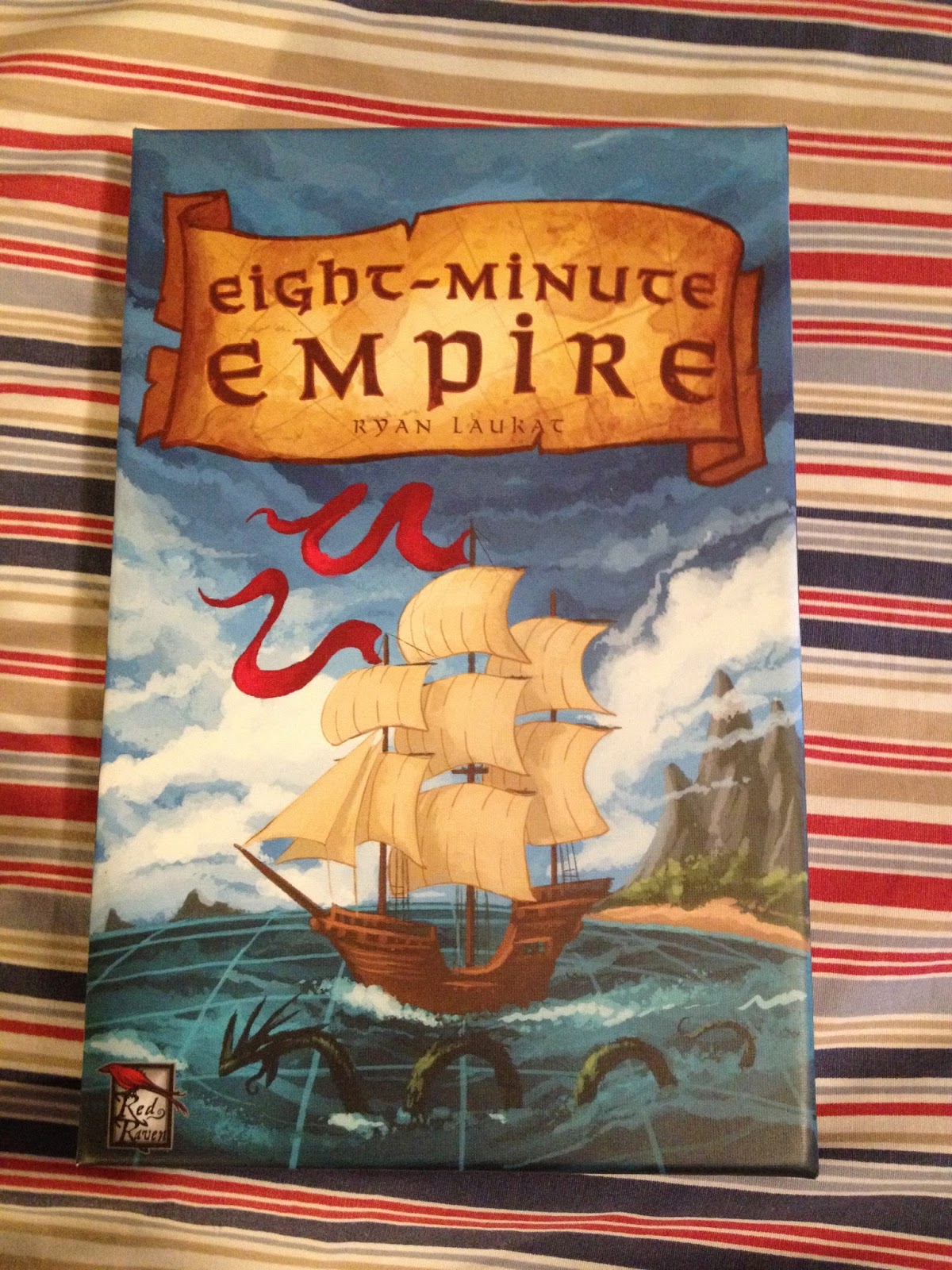
    Eight Minute Empire Review


    Eight-Minute Empire
    • Designed by Ryan Laukat
    • Published by Red Raven Games
    • For 2-5 players (I prefer 3 or 4) ages 8 and up.
    • Playtime is marketed as 8 minutes, but in reality, you're looking at 10-15.
    Catch
    Ever wanted to take over an area of land and do it in around 8 minutes?  Well, if you have, or this sounds like an intriguing idea, then this might be the game for you.

    Mechanics
    A bunch of cards in the game
    On your turn, you pick a card which has two aspects.  First, it has a set type (Ore, Tree, Ruby, Carrot, Anvil, or Wild) and then it has an action.  You keep the card in front of you, and perform the action immediately.    The trick is that only one card is free to take.  The others have a cost depending on how far they are from the free spot.  Most of the cards let you place more armies (cubes) on the board, or move your armies to neighboring regions.  At the end of the game, you get 1 point for every region you have more armies in than anyone else, you get 1 point for every continent where you control more territories than anyone else, and then you get points for the sets of cards that you have.
    Interaction
    The interaction in Eight-Minute Empire comes in two parts.  The first is which cards you select.  For instance, you may see that an opponent really wants to get rubies, so you decide to buy a Ruby card even though it costs 2.  The second is in how you move your armies.  You can try to take over someone's territory, but you have to weigh if that's worth more than expanding in other ways.  There are times where you want to compete, and there are other times where you want to let someone be on their own.

    Theme
    The theme here is weak at best.  That's not a bad thing for me.  It doesn't promise all kinds of theme, which would only detract from really solid gameplay.  I can see a bit of theme when it comes to ship movement versus land movement and such, but the theme isn't the driving force behind this game.

    Components

    Eight-Minute Empire isn't going to win any awards for components, but what's in the game is perfect to play the game.  The cubes are exactly the right size, the board is very clear, very well illustrated, the cards are simple, but completely effective.  Every component in this game is solid.  My one knock is the good tokens, that are in the game as a variant, show the good on both sides, making them hard to randomize.  That's a minor quibble, since you can put them in your hands, and then drop them one at a time, which is pretty random.

    Learning Curve
    I can explain Eight-Minute Empire in about 3 minutes, but it really takes playing the game through once to start to understand some of the strategy, and what different things are worth. That being said, the game feels at least slightly different each time you play, so strategies have to change accordingly.  All that to say, I'm still learning to play this game, but I like the challenge.  The basics don't take long to learn, but the strategy takes a good amount of time.

    Replayability
    I've played Eight-Minute Empire 7 times over the past 2 months, and I enjoy it each time I play.  The order the cards come up really changes the strategy.  Some of the variants really change the game in subtle ways while making players change the way they think.  I can easily see playing this game 100 times eventually.  It may take several months or years, but I don't see myself getting tired of it anytime soon.

    Why I like Eight Minute Empire
    A sample end game.
    Blue has 14 points.
    Red has 11 points.
    The game is challenging, it forces players to make tough choices, but it's all done in a quick manner.  If you mess up, you don't have to suffer for long.  The game feels really well balanced, most games I've played end up having very close scores.

    Why I don't like Eight Minute Empire
    Sometimes there's nothing you can do to win with the cards that come up.  Sometimes everyone else takes the card(s) you really need.

    Overall
    Eight-Minute Empire is a keeper for me.  The game intrigues me, it makes me think, other people like it.  It's simple enough to teach, plays quickly, and meets a gap in my collection.

    Would it be a good game for Tabletop?
    No. Plain and simple, I wouldn't watch this on Tabletop.  The decisions are interesting in one's head, but there's not much to actually talk about, and there's no real in game scoring to track.


    Want to buy the game? Here's a link to Amazon, and you'll help support BoBG.
    That link is fulfilled by the publisher.